• Skip to main content
  • Skip to footer
  • Home

The May 13 Group

the next day for evaluation

  • Get Involved
  • Our Work
  • About Us
You are here: Home / Archives for allblogs

allblogs

Jan 03 2024

Píldoras para la facilitación de grupos

Dentro de nuestra serie sobre «Facilitación«,  completamos el post del gran facilitador y persona Ewen Le Borgne «10 mandamientos de la facilitación grupal«, donde Ewen nos ofrece sus  «mandamientos» de facilitación. Aquí están sus mandamientos o consejos:

1. «Mantengámonos alejados del contenido, gestionemos el proceso»

2. Seamos la única persona que trabaje ABSOLUTAMENTE en el interés de TOD@S

3. A lo largo del camino, desarrollemos para todos la «alfabetización del proceso«

4. Siempre que podamos, involucremos y co-facilitemos con otr@s.

5. No nos enamoremos de nuestros propios intereses, deseos, aficiones, no se trata de nosotros sino de ELL@S

6. Recuerda tu yoda interior: abraza tu yo ético

7. Seamos conscientes de quién somos: el «yo como instrumento»

8. Seamos la facilitación que se quiere ver en todo lo que hacemos.

9. Autorreflexión y superación personal

10. ¡Trabajemos con (muchos) otros y seamos agradecidos!

Sigamos soñando con trabajar en grupos y con facilitar la colaboración
Written by cplysy · Categorized: TripleAD

Jan 02 2024

Liderazgo como arte y facilitación

L@s líderes deben ser (a) más artistas que científic@s, (b) más facilitador@s que controlador@s, activando el autocontrol con las personas que lideran, para:

1. Contextualizar y analizar con perspectiva

2. Facilitar más que controlar 

3. Ser consciente del poder y sus privilegios

4. Escuchar para aprender y hacer preguntas que estimulen

5. Ser auténtic@, compartiendo luchas, miedos y dudas

6. Conseguir empatía y conexión

7. Si hay sobreesfuerzo y pérdida de perspectiva: Volver a conectar con el propósito y las prioridades

8. Enfoque situacionalmente a la toma de decisiones

9. Resituar propósito y prioridades/valores

10. Tomar un enfoque de aprendizaje frente a las malas (y buenas) decisiones

Written by cplysy · Categorized: TripleAD

Jan 01 2024

La gestión del conocimiento en la estrategia y en la práctica

He basado este post en materiales sobre gestión de; conocimiento (GC) en UNICEF

¿Y qué es GC en UNICEF? Es “La captura, organización, intercambio y uso del conocimiento para mejorar el desempeño organizacional hacia el desarrollo y los resultados de desarrollo y humanitarios para los niños”. – Estrategia Global de Medio Plazo de Gestión del Conocimiento (2021-2022).

Áreas de trabajo de la GC: La GC no es una actividad ad hoc, sino que debe planificarse deliberadamente para alinearse con los objetivos del programa, operativos u organizacionales. El objetivo es utilizar continuamente la GC para mejorar el rendimiento en:

  • Planificación de su trabajo de GC
  • Capturar y documentar el conocimiento.
  • Crear, empaquetar y difundir
  • Administrar contenido
  • Intercambio de conocimientos (dentro de la oficina/organización/red de socios)
  • Espacios para aprender y reflexionar
  • Retener el conocimiento del personal
  • Evaluar el uso del conocimiento

¿Qué significa ser campeón/a de GC? Podemos apoyar y promover la GC aplicando los siguientes tres pilares:

1. Establecer un entorno propicio y una cultura para utilizar plenamente GC

2. Promoción y participación en iniciativas de GC

3. Aprovechar los sistemas de la organización para institucionalizar la gestión del conocimiento

¿Qué podemos hacer para que la GC tenga éxito? ¿Qué debe implementarse para que podamos cosechar los beneficios de hacer GC? Para beneficiarnos plenamente de la GC, necesitamos los siguientes impulsores del marco de GC: Gobernanza, Recursos (humanos y financieros)-Personas, Cultura-Procesos y Tecnología

Lo siguiente puede ayudarnos a aplicar y defender GC en la organización:

· Anclar nuestro trabajo de GC en las necesidades de nuestra organización

· Incrustarlo en el trabajo existente

· Traiga a todo nuestro equipo u organización

· Construir sobre nuestros esfuerzos y logros de GC en los años siguientes (quick wins)

Written by cplysy · Categorized: TripleAD

Dec 27 2023

Should DataViz be Easy?

For Christmas dinner this year I made my family spinach and pasta rotolo. It’s a baked pasta dish that involved making fresh pasta, rolling it flat, filling it with a spinach/ricotta mixture, and rolling it up like a jelly roll. Then it gets cut into small little scroll like pieces and baked upright with a homemade creamy parmesan rosé sauce until the top ends of the pasta crisp up.

And while it ended up a bit of a mess and not quite picture perfect, it was delicious.

Years ago, pre-covid and before we were vegetarians, my in-laws would take us out to a fancy restaurant for Christmas eve dinner. It was a long multi-course meal that usually included the kind of fancy dishes you would never make at home.

Both of these examples are the kinds of things you don’t do often. They either require too much work or too much money to be a regular thing for most people.

That’s certainly true for us. The rest of the year our pasta comes from a little cardboard box with sauce that comes from a can. And the only time we have a multi-course meal is when one of us opens up a bag of chips to snack on before dinner.

Sometimes you want special. But most of the time, you just need to eat.

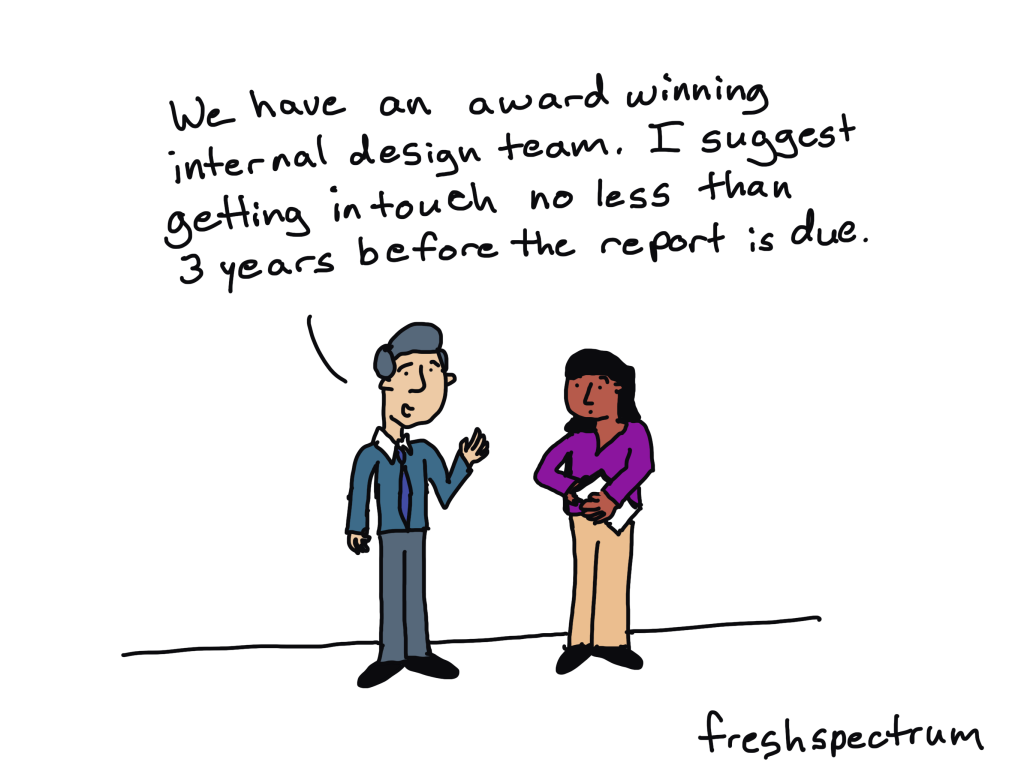
Comic Guy Says, "We have an award winning internal design team. I suggest getting in touch no less than 3 years before the report is due."

DataViz is not just for special occasions.

Visuals are important.

And when there is too much information for people to process, visuals are even more important.

Without pictures the web would just be overwhelming blocks of text. It’s why most social media platforms look like living comic books. Visuals allow us to scan before we decide to dive in and read. In essence, the pictures are critically important navigation tools.

I joke sometimes that data visualization is really just academically acceptable illustration. In settings where you have to defend the inclusion of any image, such as an academic journal, a chart gives you a simple way to include pictures. But most of the time, even including those kinds of pictures was not requirement.

Now-a-days that’s changing. DataViz and good design are no longer just for special occasions.

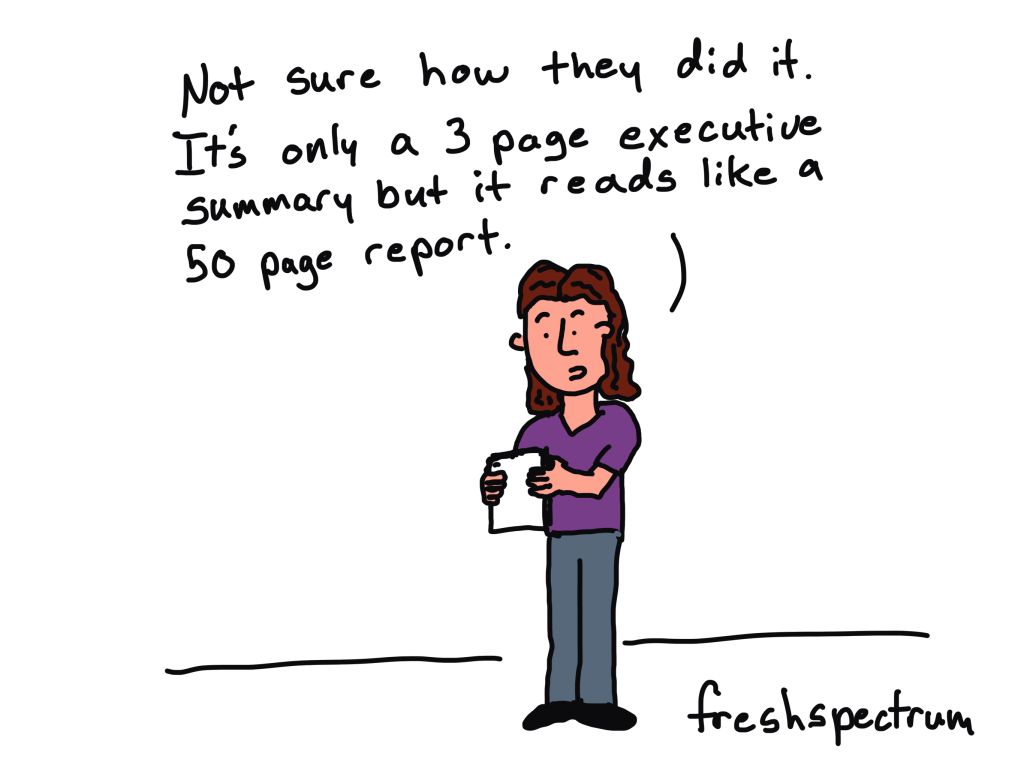
Comic Lady Says, "Not sure how they did it. It's only a 3 page executive summary but it reads like a 50 page report."

DataViz home cooks wanted.

Some of the coolest innovations over the last decade are not tools that allow us to do things that have not been done before. Instead they are things that bring better dataviz and design to the masses.

  • You don’t need a deep dive into Adobe creative cloud to create high quality infographics. You can start with Canva.
  • You don’t need a deep dive into javascript, R, or python to creative interactive web reports or apps. You can start with a WordPress website builder.
  • You don’t need a deep dive into Tableau or PowerBI to create automated interactive charts. You can start with Flourish or Datawrapper.

With these new tools, and the right process, you can create high quality DataViz and designs easier and faster. And most people won’t know the difference (including your boss or clients).

Comic person 1, "We found the best reporting strategy mixes infographics, dashboards, and slidedocs in order to best meet the needs of our different audiences."
Comic person 2, "But the contract only lists one report."

So, should DataViz be easy?

Yes.

YES!!!

I would love it if more organizations put more time and money into DataViz and design. But until that happens, I think the best thing we can do as a data field is to learn how to use the tools we have to make the process easier and faster.

I and I hope with this blog, along with the workshops and courses I’m developing, I can continue to help make that process easier in the new year.

Written by cplysy · Categorized: freshspectrum

Dec 20 2023

Stratified Random Sampling in Evaluation

This article is rated as:


In our evaluations, we use varying methods to collect random, representative samples. In most instances, collecting data on all members of a population isn’t feasible (i.e., too expensive and time intensive). Therefore, we rely on sampling methods to make generalizations about our population of interest while minimizing bias. 

Random sampling is one of the simplest sampling methodologies used in evaluations. Random sampling treats all members of the population equally; thus, everyone has an equal chance of being sampled. That is, we randomly sample a specified number of individuals from the overall population. For quantitative data collection, see our “easy” and “hard” guides for finding the right sample size.

However, often our evaluations are interested in differences between population characteristics (e.g., gender or ethnicity). While a random sample of sufficient sample size would likely capture individuals falling within the varying levels of these characteristics, it is not guaranteed that each level of these characteristics is sampled. In these cases, we would employ stratified random sampling.


What is Stratified Random Sampling?

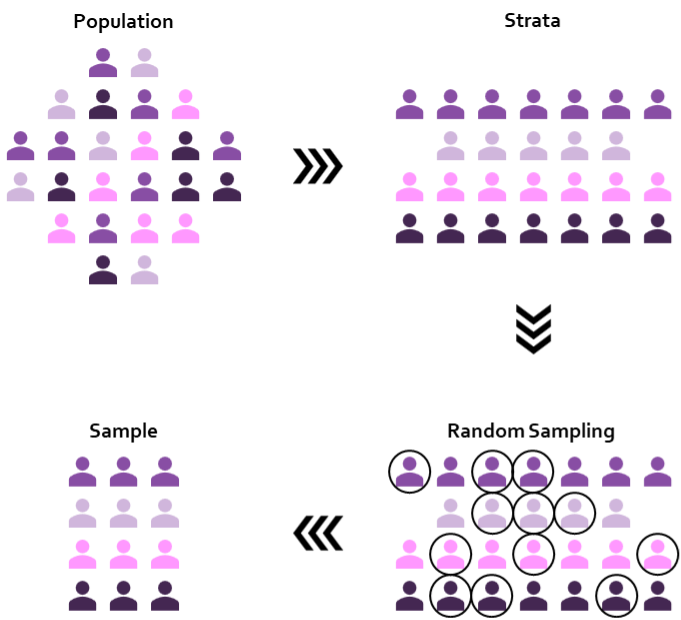
Stratified random sampling is a sampling methodology used to capture a representative cross-section of a population. Rather than randomly selecting from a pool of all members of a population (as in random sampling), stratified sampling divides the population of interest into distinct subgroups or strata based on designated characteristics. With the population stratified, a random sample is taken from each of the stratum. This ensures that each subgroup is adequately represented in the final sample.


Types of Stratified Sampling

Stratified random sampling can be split into two variations: (1) Proportionate stratified sampling and (2) Disproportionate stratified sampling.

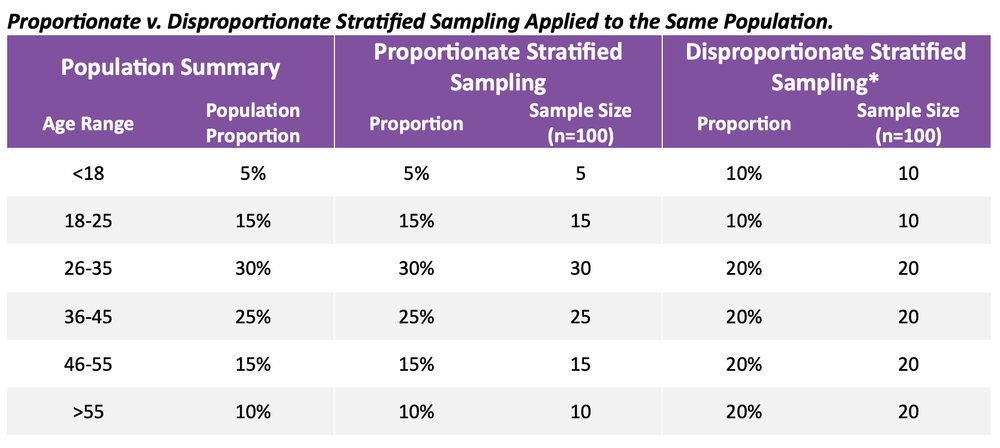
(1)    Proportionate stratified sampling: the size of each sample drawn from each stratum is proportionate to the size of each stratum in the population of interest. 

Example

We want a proportionate stratified sample based on participant age group (youth, adult, and senior). Knowing that our population has 40% youth, 50% adult, and 10% senior participants, our stratified sample should reflect these proportions. That is, if we sample 100 individuals, the sample should contain 40 youth, 50 adult, and 10 senior participants.


(2)    Disproportionate stratified sampling: the size of each sample drawn from each stratum is not proportionateto the size of each stratum in the population of interest.

 Example

Our evaluation wants to better understand Indigenous perspectives related to a given program. However, Indigenous participants are underrepresented within the program accounting for only 20% of all participants. Therefore, to get a better understanding of Indigenous perspectives, if we sample 100 individuals, the sample could contain 50 Indigenous participants and 50 non-Indigenous participants.


Choosing between proportionate and disproportionate stratified sampling depends on the evaluation and the importance of each stratum. Proportionate sampling is effective when we want to maintain the proportionality and representativeness of our population. On the other hand, disproportionate sampling may be more appropriate when certain strata require more in-depth evaluation, particularly for individuals within underrepresented strata.

*Disproportionate stratified sampling may vary depending on the evaluation question. In this example, participants 26 and older are more relevant for the evaluation. Thus, these age groups have larger sample sizes relative to younger age groups, regardless of the actual proportion of each age group within the population as a whole.


Why use Stratified Random Sampling?

Stratified random sampling helps to provide representative samples in our evaluations. By dividing a population into strata and randomly sampling from each stratum, we can better reflect the diversity within our population of interest. Stratified random sampling assists in reducing underrepresentation and overrepresentation within specific groups of our strata, allowing us to better capture important population characteristics that may be missed with a simple random sample. 

Particularly, stratified random sampling is beneficial to evaluate the differences within stratum. That is, stratified random sampling allows us to make better comparisons between different population demographics or characteristics relevant to the evaluation that may otherwise be overlooked. Observing group differences across stratum can also promote diversity, equity and inclusion in evaluation as some groups might be heavily represented in an outcome relative to another group.


Limitations of Stratified Random Sampling

Stratified random sampling is not without limitations. These limitations include, but are not limited to:

  • Misclassification of Strata

    • While demographic strata, such as age range, may be clearly defined, other strata may be more nuanced. For example, ethnicity may not be clear for all members of a population, with some individuals identifying with one or more ethnic groups.

  • Time and Cost

    • When time and cost are limiting factors, splitting a population into appropriate strata while avoiding misclassification can become impractical. Dividing the population into strata and identifying a random sample within stratum require appropriate time and resources for planning and execution that can add to the logistical demands of the overall evaluation.


Wrapping Up

Stratified random sampling can be an effective method to provide comprehensive perspectives about your evaluation population. The key advantage of stratified random sampling lies in its ability to offer a nuanced portrayal of a population, by providing insights from all defined subgroups. The pay-off includes highlighting perspectives of underrepresented groups within the population that may otherwise be overlooked or overshadowed by other overrepresented groups.

While stratified random sampling can be applied to both quantitative and qualitative data collection, it can provide additional support for qualitative data collection, where sample sizes may be limited. For example, think about the time and resources required to conduct a single interview versus having a participant fill out a short survey. We are working on a Stratified Sampling Tool designed specifically for qualitative data collection. Our tool will streamline the qualitative data collection process by providing stratified random samples derived from a defined stratum. Keep an eye out for its release in early 2024.

Written by cplysy · Categorized: evalacademy

  • « Go to Previous Page
  • Go to page 1
  • Interim pages omitted …
  • Go to page 63
  • Go to page 64
  • Go to page 65
  • Go to page 66
  • Go to page 67
  • Interim pages omitted …
  • Go to page 310
  • Go to Next Page »

Footer

Follow our Work

The easiest way to stay connected to our work is to join our newsletter. You’ll get updates on projects, learn about new events, and hear stories from those evaluators whom the field continues to actively exclude and erase.

Get Updates

Want to take further action or join a pod? Click here to learn more.

Copyright © 2026 · The May 13 Group · Log in

en English
af Afrikaanssq Shqipam አማርኛar العربيةhy Հայերենaz Azərbaycan dilieu Euskarabe Беларуская моваbn বাংলাbs Bosanskibg Българскиca Catalàceb Cebuanony Chichewazh-CN 简体中文zh-TW 繁體中文co Corsuhr Hrvatskics Čeština‎da Dansknl Nederlandsen Englisheo Esperantoet Eestitl Filipinofi Suomifr Françaisfy Fryskgl Galegoka ქართულიde Deutschel Ελληνικάgu ગુજરાતીht Kreyol ayisyenha Harshen Hausahaw Ōlelo Hawaiʻiiw עִבְרִיתhi हिन्दीhmn Hmonghu Magyaris Íslenskaig Igboid Bahasa Indonesiaga Gaeilgeit Italianoja 日本語jw Basa Jawakn ಕನ್ನಡkk Қазақ тіліkm ភាសាខ្មែរko 한국어ku كوردی‎ky Кыргызчаlo ພາສາລາວla Latinlv Latviešu valodalt Lietuvių kalbalb Lëtzebuergeschmk Македонски јазикmg Malagasyms Bahasa Melayuml മലയാളംmt Maltesemi Te Reo Māorimr मराठीmn Монголmy ဗမာစာne नेपालीno Norsk bokmålps پښتوfa فارسیpl Polskipt Portuguêspa ਪੰਜਾਬੀro Românăru Русскийsm Samoangd Gàidhligsr Српски језикst Sesothosn Shonasd سنڌيsi සිංහලsk Slovenčinasl Slovenščinaso Afsoomaalies Españolsu Basa Sundasw Kiswahilisv Svenskatg Тоҷикӣta தமிழ்te తెలుగుth ไทยtr Türkçeuk Українськаur اردوuz O‘zbekchavi Tiếng Việtcy Cymraegxh isiXhosayi יידישyo Yorùbázu Zulu