Something wonderful — and terrible — has started happening.
Researchers, evaluators, and scientists complete my online courses. Or they bring me in for private workshops.
And they start applying what they learned. GREAT!!!
But it’s a little off. OOPS.
This is entirely my fault. I’ve been recommending that we use icons for years now — but I haven’t been clear enough about how to use them, and how not to use them.
In this blog post, you’ll see 8 different types of icon use. The good, bad, and ugly.
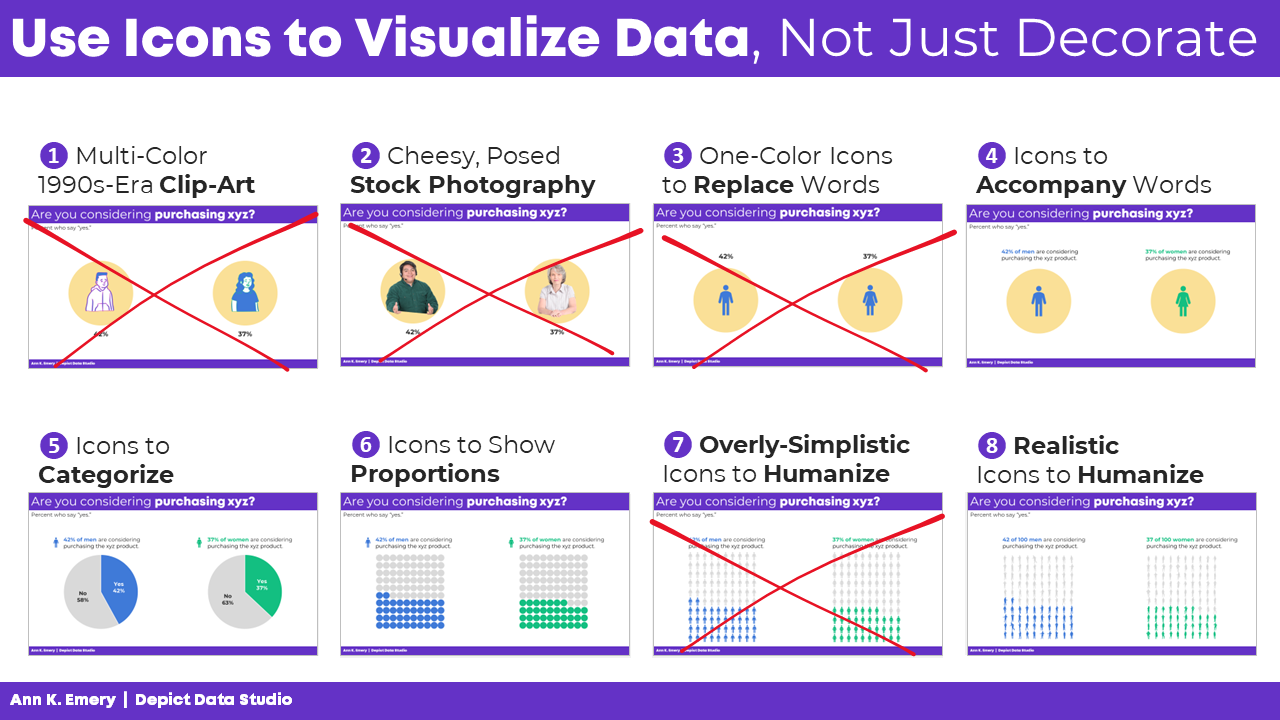
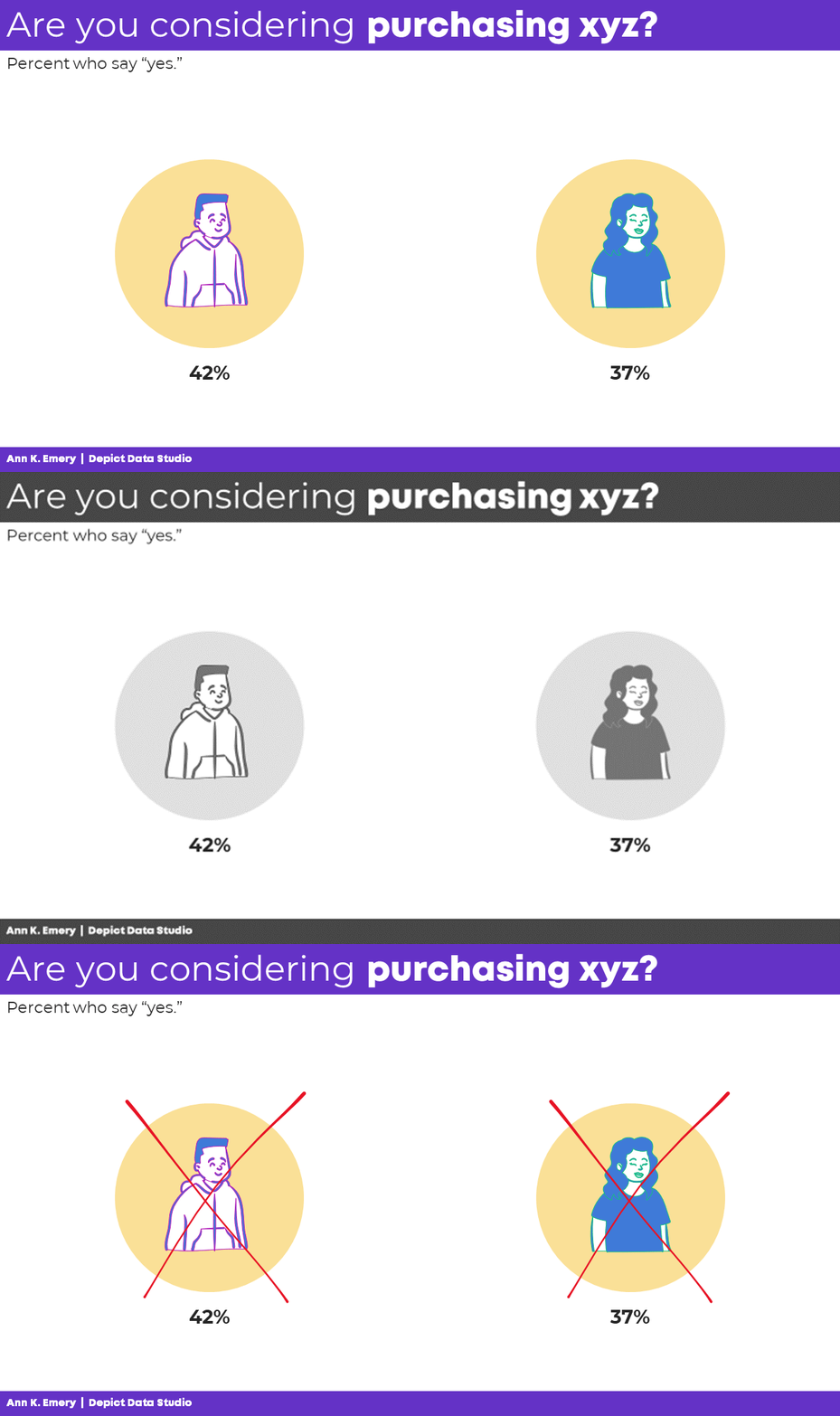
(1) Multi-Color 1990s-Era Clip-Art: NOOOOOOOO
Let’s start with what not to do: clip-art.
Icons and clip-art are similar, but not identical.
Icons use one color, so they hold up well in grayscale printing, or when very small.
Clip-art uses several colors, so it doesn’t hold up well in grayscale printing, and it’s hard to see when it’s small.
For these obvious reasons — clip-art is outdated and hard to see — clip-art gets The Big Red X.
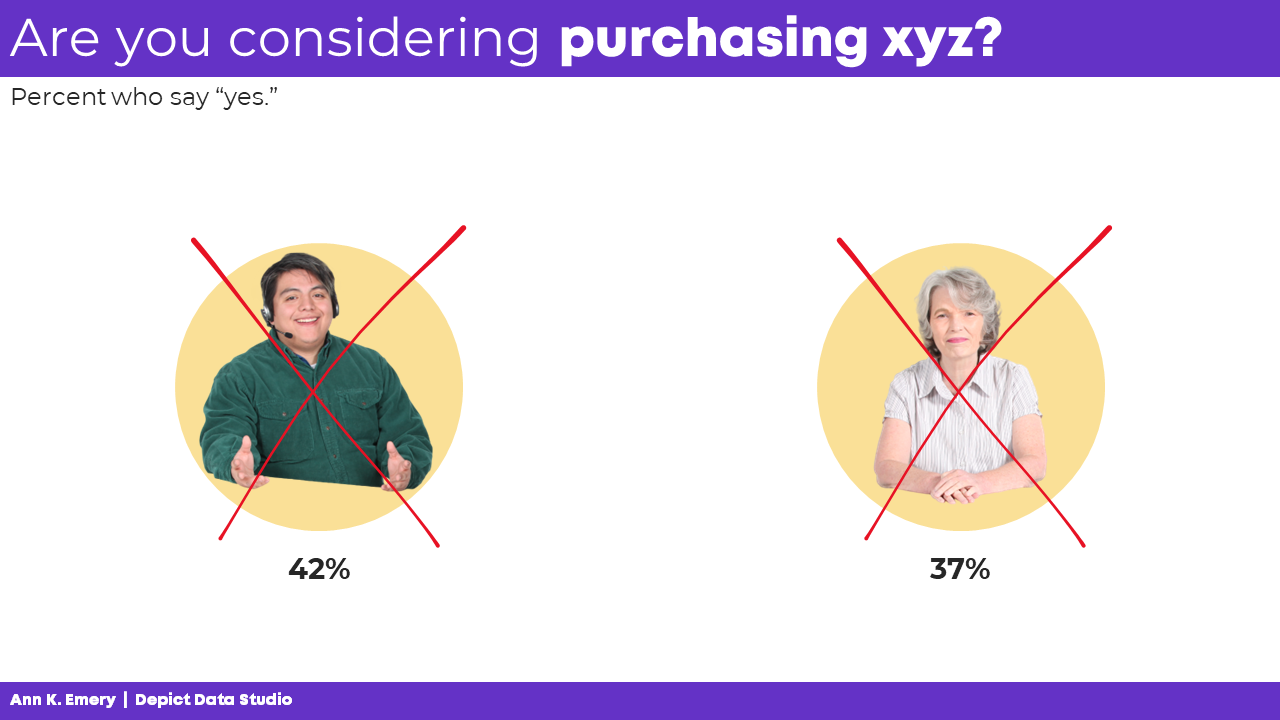
(2) Cheesy, Posed Stock Photography: NOOOOOOOO
Gosh, I hope this one’s obvious.
I love adding photographs to reports, slideshows, and infographics.
But not the cheesy, posed type, like this.
Another Big Red X.
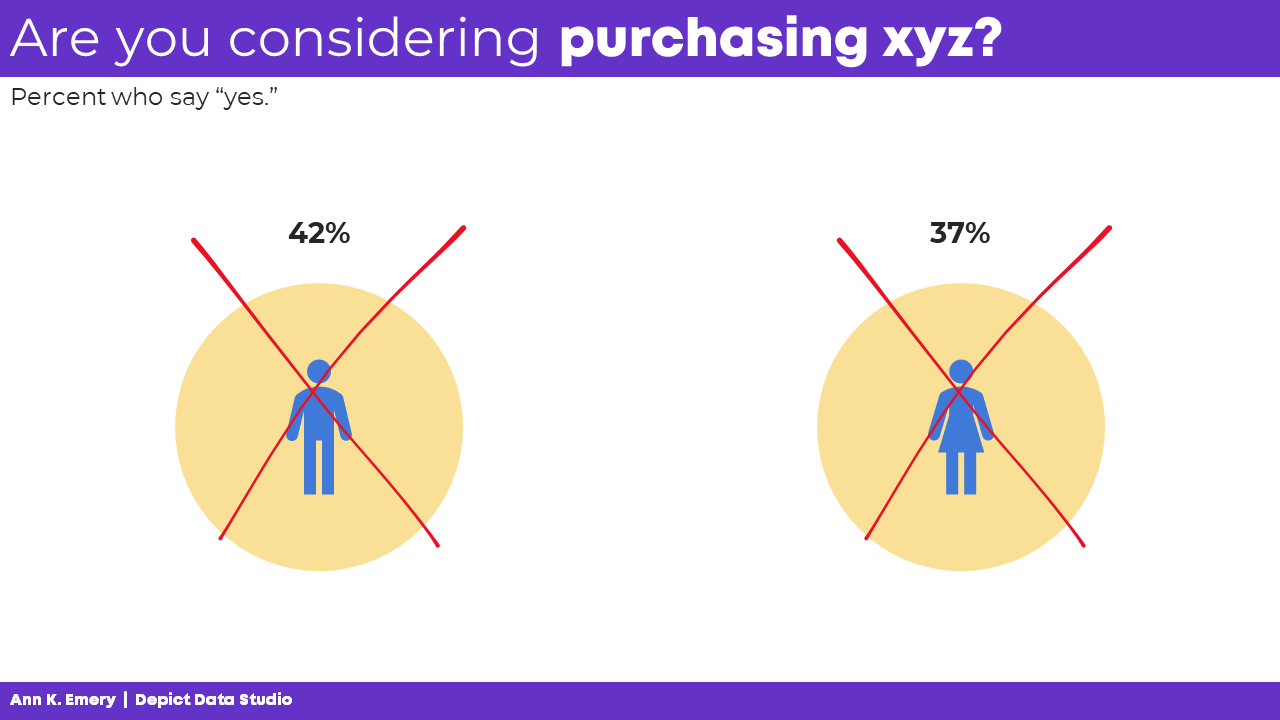
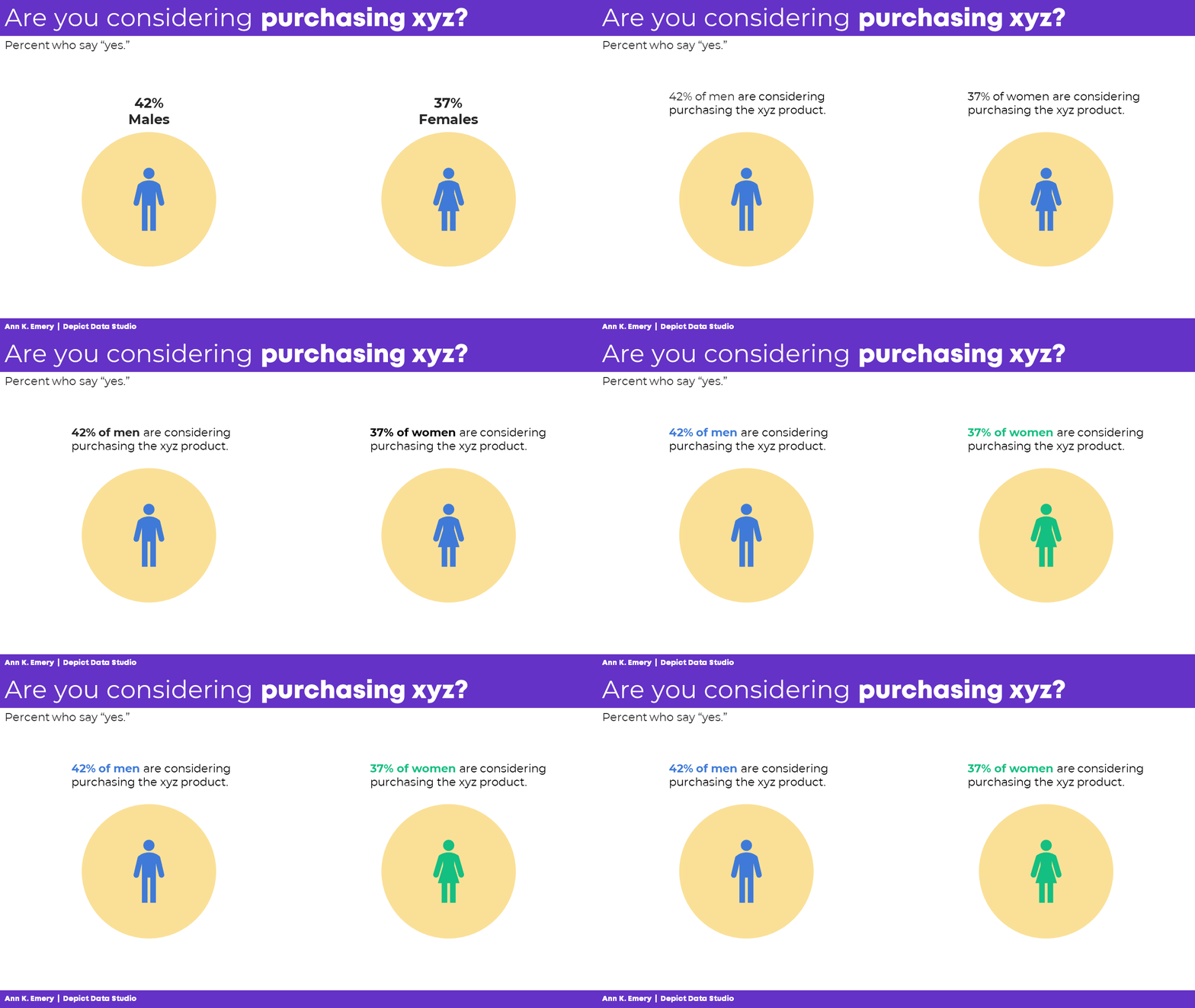
(3) One-Color Icons to Replace Words: NOOOOOOOO
One-color icons are okay.
But icons can only accompany words, not replace words.
(4) Icons to Accompany Words: Yes!
Let’s start by adding words: males and females.
Then, we’ll turn those choppy phrases into full sentences to remove guesswork.
We’ll bold a few key words to make it more skimmable.
We’ll color-code the keywords to match the icons (blue keywords for blue icons).
Finally, we’ll color-code by category: blue for one group, and green for another. You’d obviously use your brand colors, not mine, but the technique is the same: one hue per category.
Even if you’re the slowest typer in the world, these bare-minimum edits should only take a minute.
(5) Icons to Categorize: Yes!
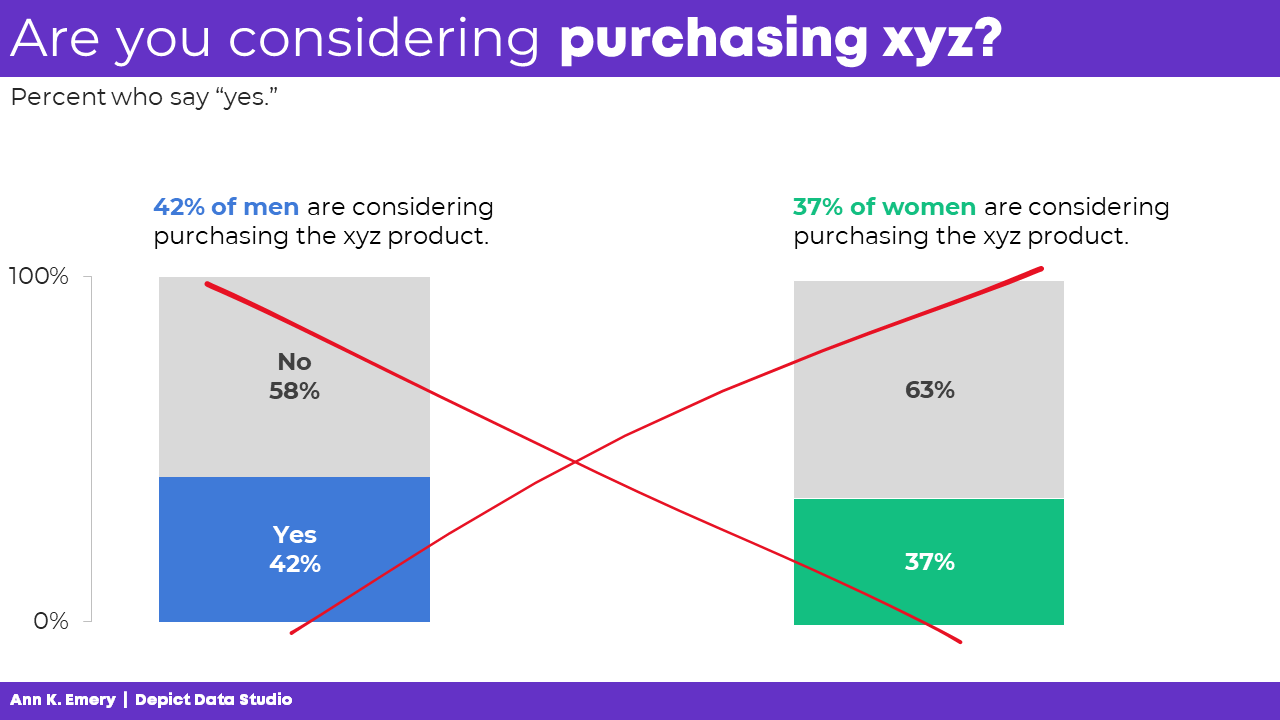
Next, let’s add some actual, ya know, graphs.
Bar charts are fine, but they’re super boring if that’s all we have.
These are binary variables — a.k.a. yes/no variables — so two-slice pies are perfectly fine.
(Here’s my list of pie chart guidelines if you’re not familiar with my stance on pies.)
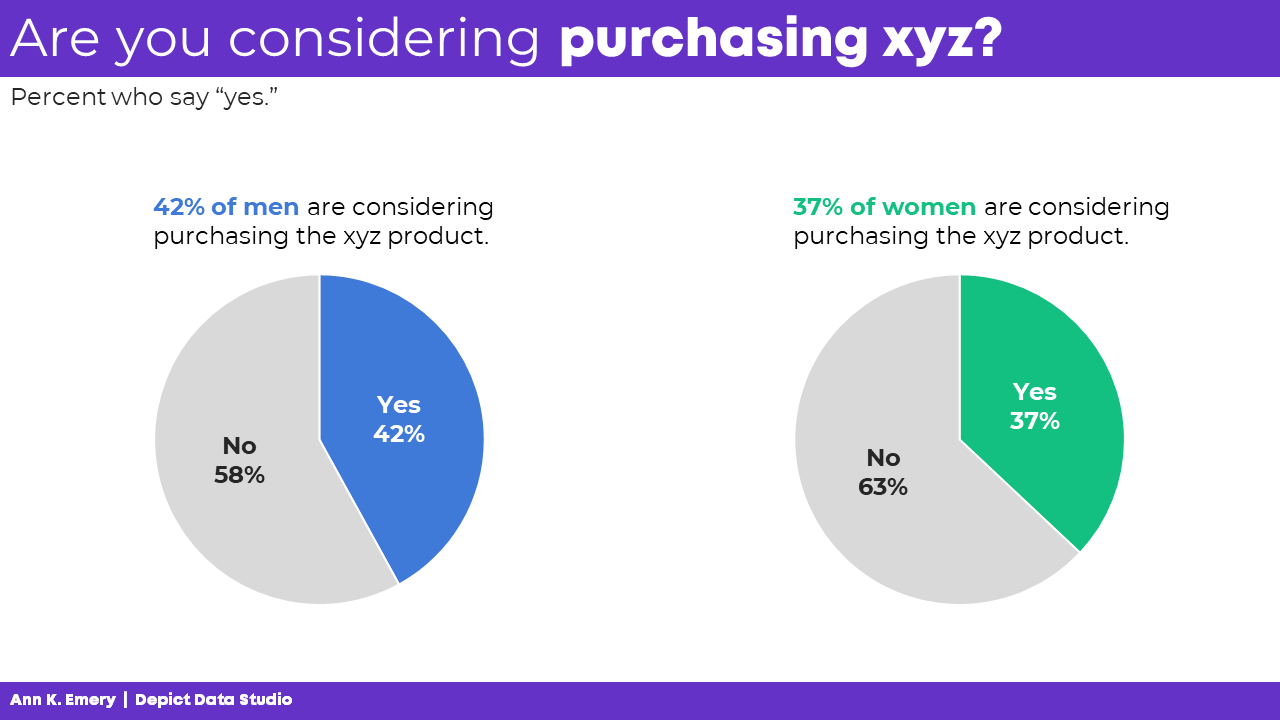
This is where we can add icons to categorize.
You see the difference, right?
I’m not a fan of using icons on their own, like the previous examples. They feel overly-simplistic and dumbed-down. But I am a fan of using icons to accompany other graphs, and to aid with categorization, like this:

We’re not limited to pies for binary variables.
We could use pies, donuts, or square pies.
No matter the graph type, the icon usage is the same: They’re accompanying the graphs, and aid with categorization.
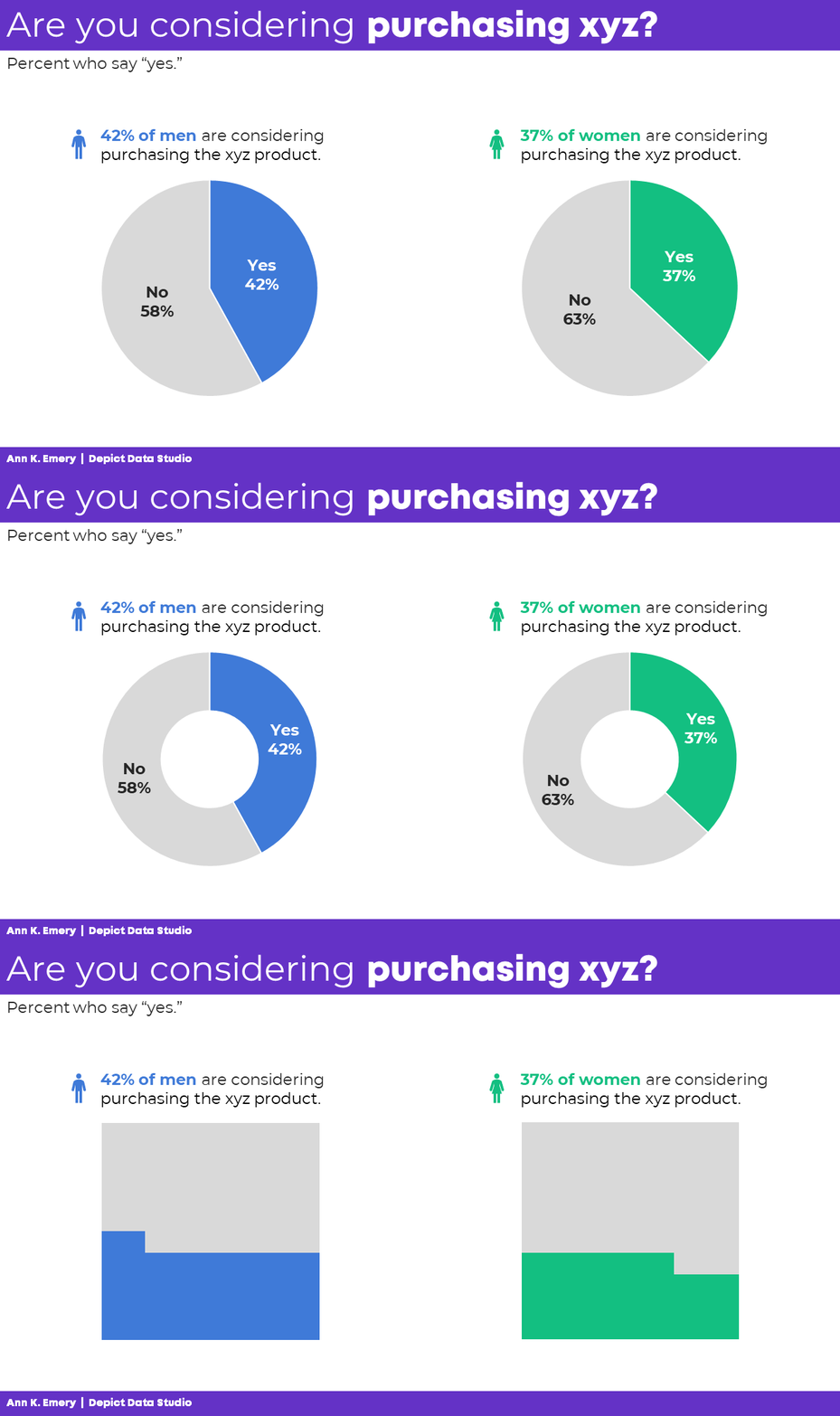
(6) Icons to Show Proportions: Yes!
We can also use icons as the visualization itself.
Collages of icons are called icon arrays. The square version is also known as a waffle chart.
For bonus points, we could add the male/female icons to aid with categorization, too.
You see the distinction, right? The primary icons (the collages of squares or circles) are used to visualize the data, not just decorate it.
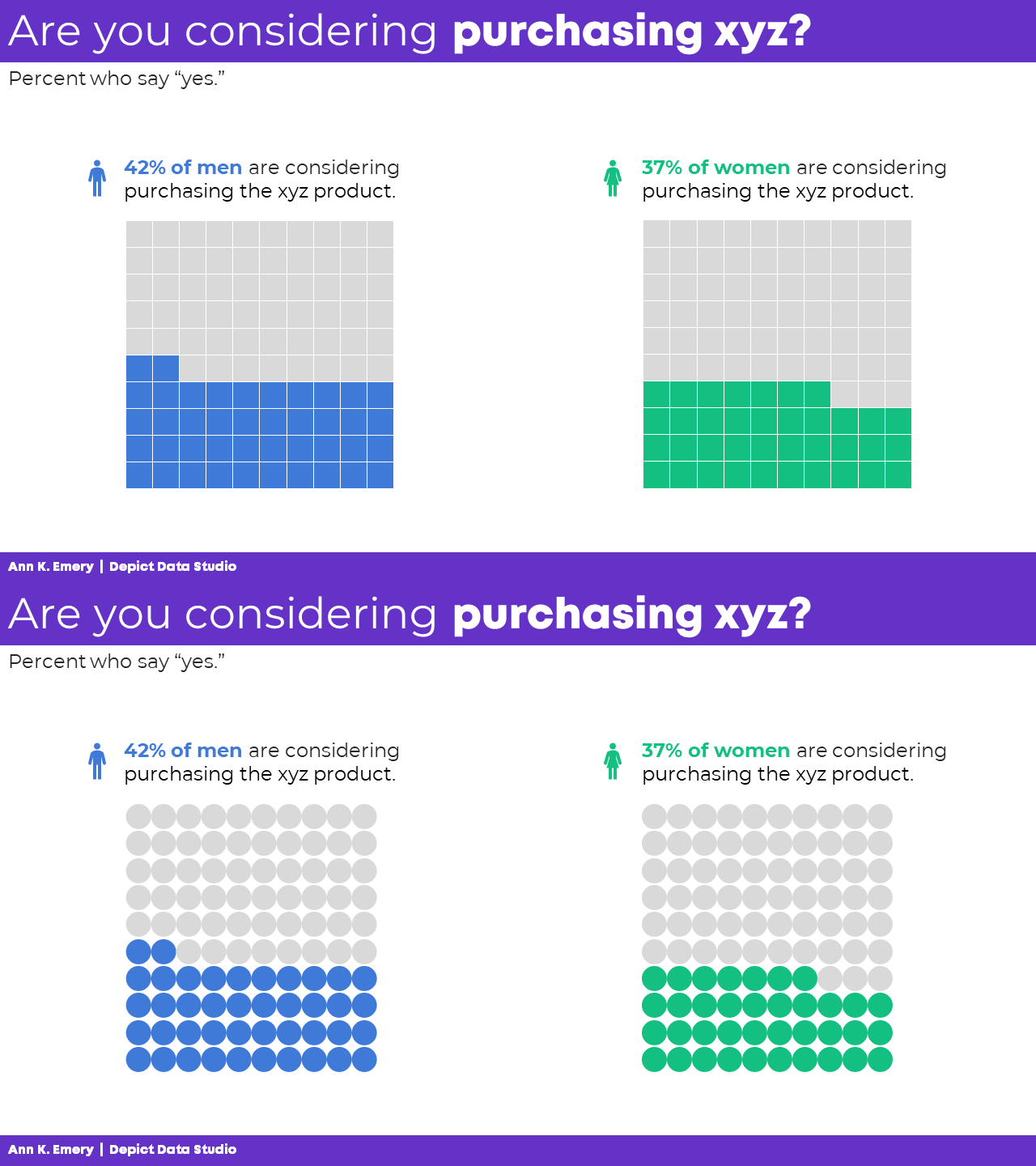
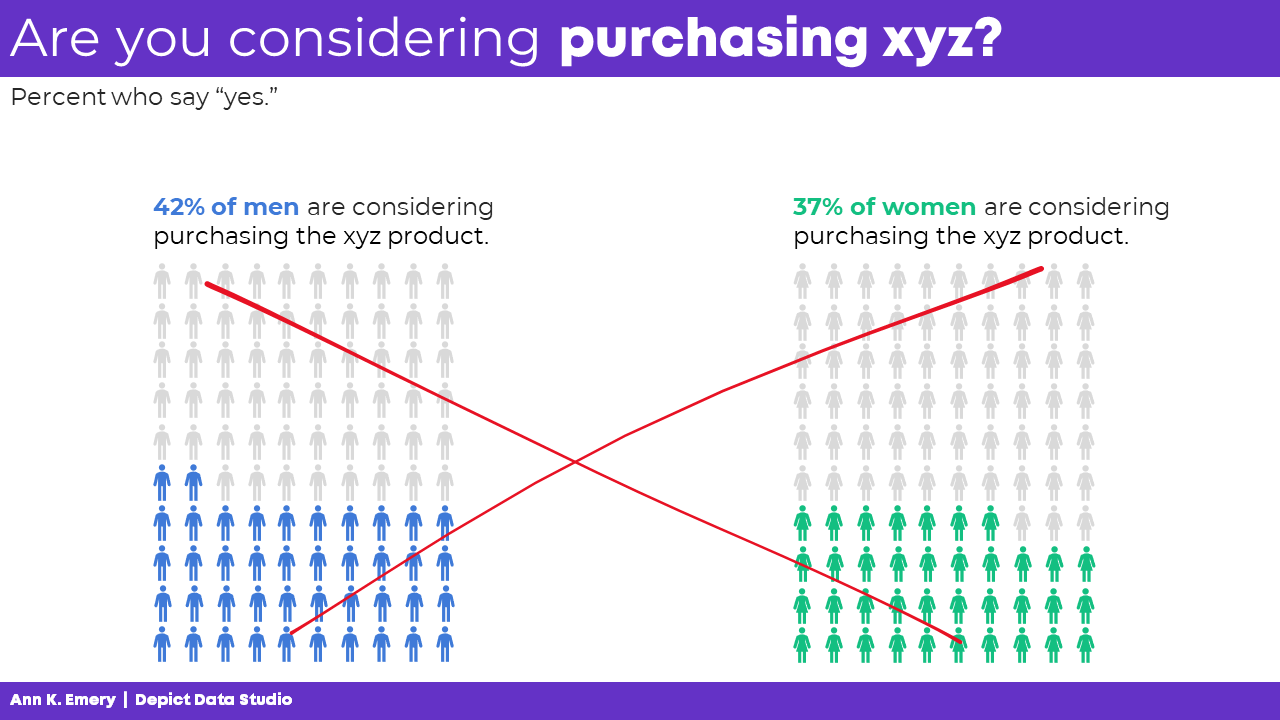
(7) Overly-Simplistic Icons to Humanize: NOOOOOOOO
The only thing worse than one dumbed-down Gingerbread Person is a hundred of them.
NO MORE GINGERBREAD PEOPLE!!!
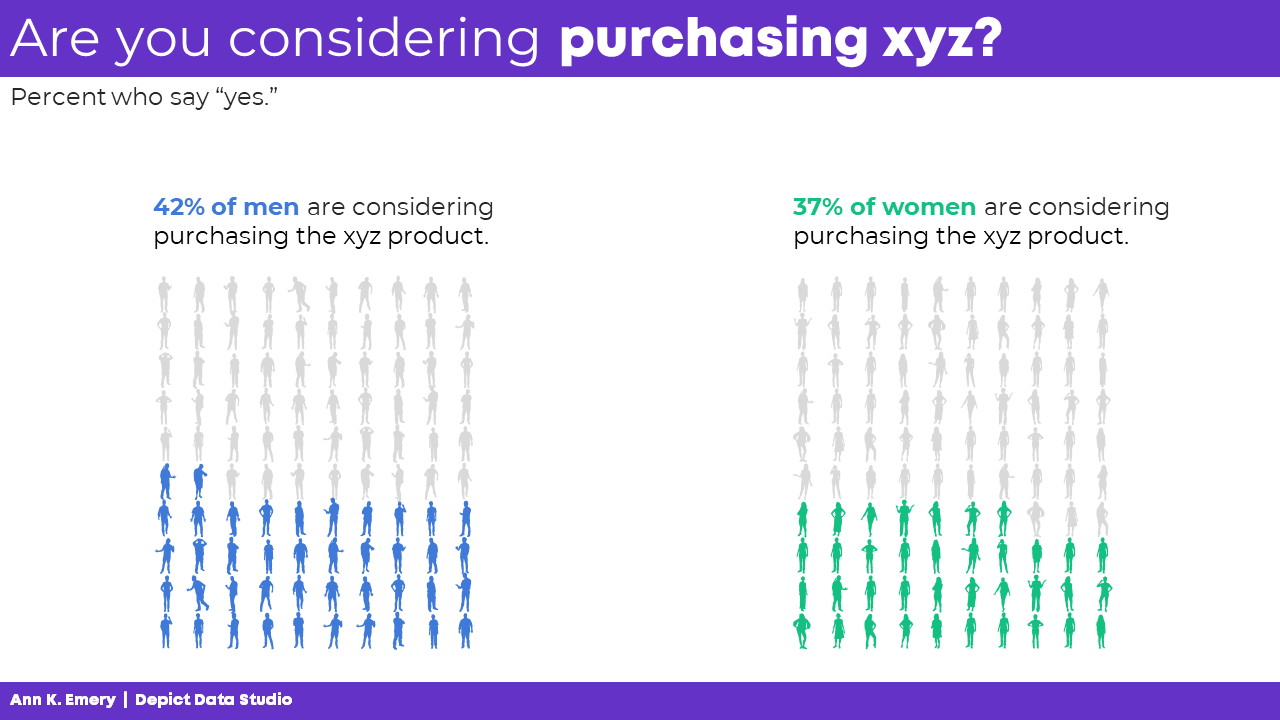
(8) Realistic Icons to Humanize: Yes!
I am a fan of using realistic icons to humanize the data.
You see the differences, right? We’re not using single icons just to decorate, like the first couple examples. We’re using icons to categorize and/or to show proportions.
And we’re not using dumbed-down Gingerbread People. We’re using realistic human silhouettes.
More Examples of Realistic Icons to Humanize
I want to normalize these realistic icons for you. Here are a couple examples from the wild:
- The proportion of female chairs in board or CEO positions in German companies
- COVID-19 won’t spread as easily when Oregon reaches herd immunity
Using Smaller Denominators
All icons — squares, circles, Gingerbread People, and realistic human icons — get tricky to read when they’re tiny.
In some projects, we can simplify our fractions.
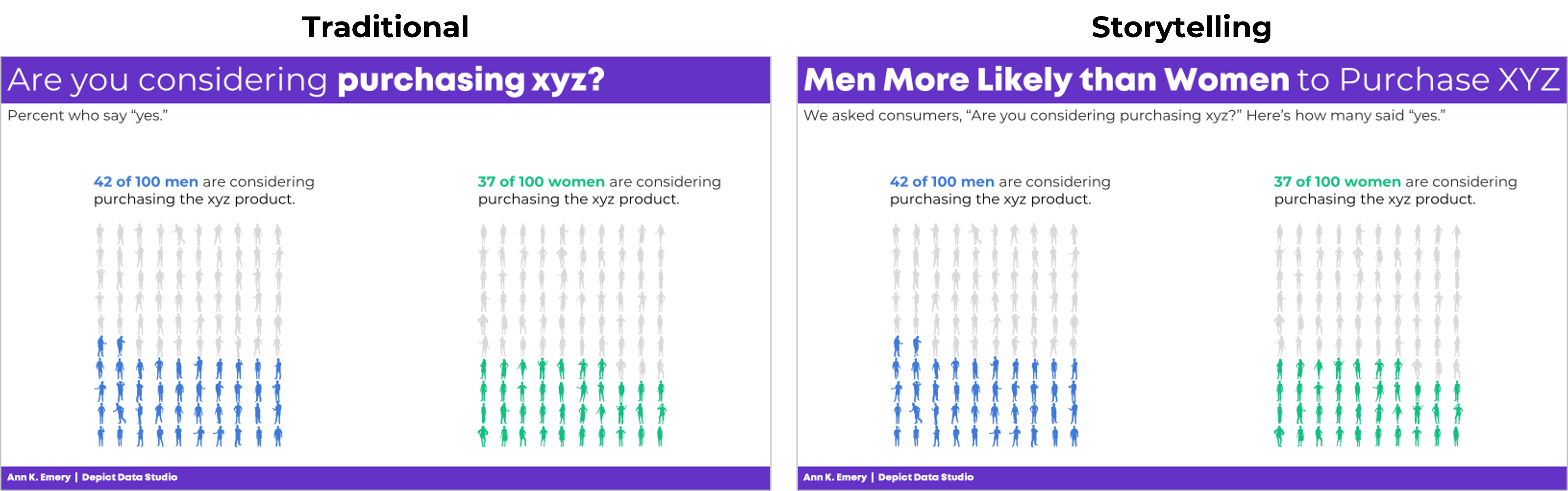
I tried changing 42% of men to 42 of 100 men, and then to 21 of 50 men. That worked fine!
But when I tried changing 37% of women to 37 of 100 women, and then to 18.5 of 50 women… yuck. If our unit of analysis is people, we can’t talk about or visualize half a person. That’s confusing to our audiences.
So while I’d prefer to simplify the fraction, I can’t in this specific example.
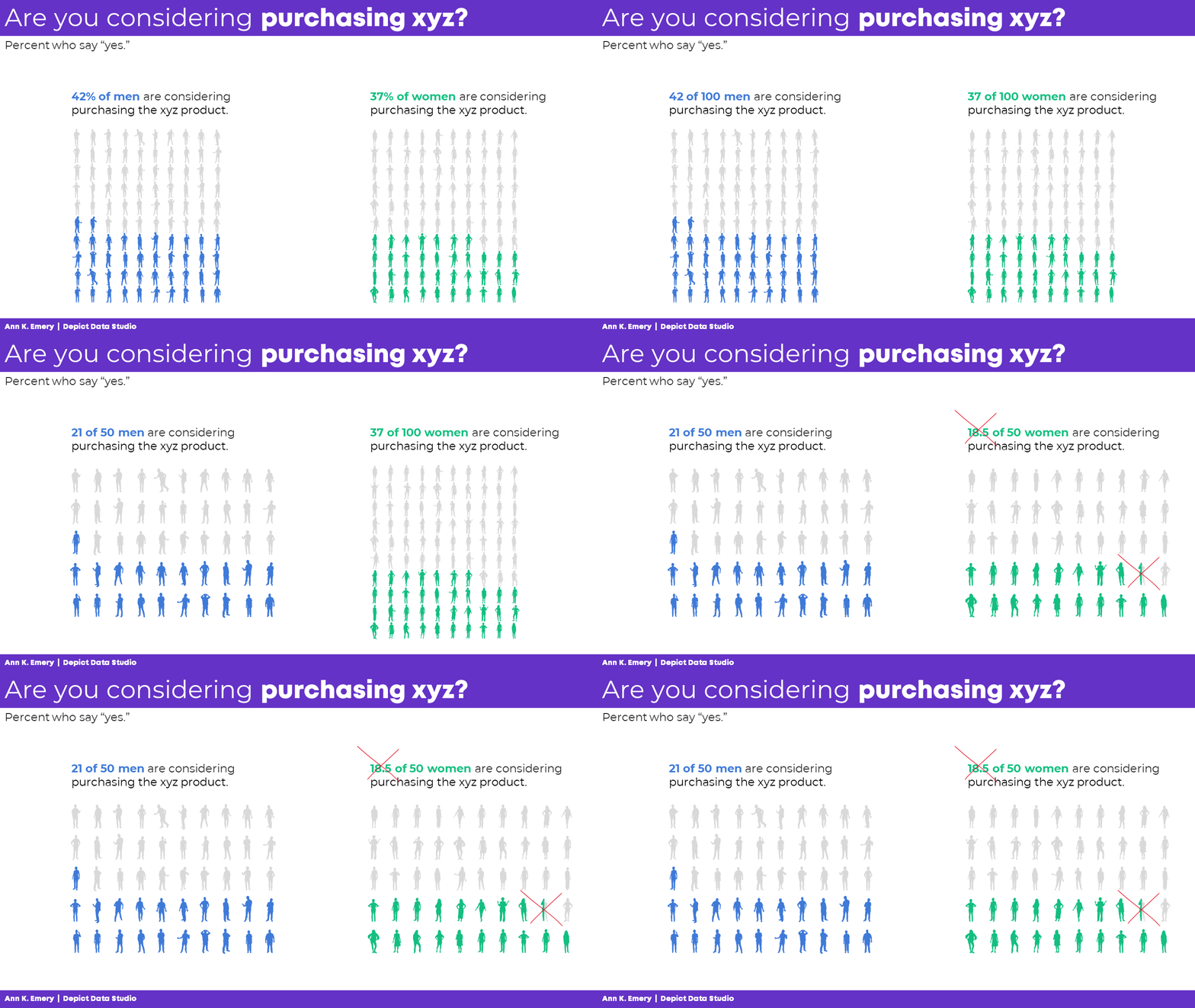
Traditional and Storytelling Versions
Hopefully you’ve heard me talk about traditional vs. storytelling graphs before. If not, you can watch this video for a quick overview. Both versions are correct, but they’re correct for different types of audiences.
The Bottom Line
There are several different ways to use icons in data visualization, and some are better than others.
I don’t recommend clip-art (version 1) or cheesy stock photos (version 2).
I don’t recommend icons to replace words (version 3).
I don’t even recommend icons on their own (version 4).
Instead, at a bare minimum, we should be using icons to accompany other graphs and to categorize (version 5).
Better yet, I’d prefer that we use icons (like little squares or circles) to show proportions (version 6).
And when our unit of analysis is humans, I’d prefer that we use realistic human icons (version 8) and never the dumbed-down Gingerbread People (version 7).
Your Turn
Which version of icons are you currently using? Which one might you try in the future? Comment below with all your ideas! Bonus points for sharing links to your public-facing projects so we can learn from each other.


 English
 Afrikaans
 Shqip
Shqip አማርኛ
አማርኛ العربية
 Հայերեն
 Azərbaycan dili
 Euskara
 Беларуская мова
 বাংলা
বাংলা Bosanski
 Български
 Català
 Cebuano
 Chichewa
 简体中文
简体中文 繁體中文
繁體中文 Corsu
Corsu Hrvatski
 Čeština
 Dansk
Dansk Nederlands
 Esperanto
 Eesti
Eesti Filipino
 Suomi
Suomi Français
 Frysk
Frysk Galego
 ქართული
 Deutsch
 Ελληνικά
 ગુજરાતી
 Kreyol ayisyen
 Harshen Hausa
 Ōlelo Hawaiʻi
 עִבְרִית
 हिन्दी
 Hmong
Hmong Magyar
 Íslenska
 Igbo
Igbo Bahasa Indonesia
 Gaeilge
 Italiano
 日本語
日本語 Basa Jawa
 ಕನ್ನಡ
ಕನ್ನಡ Қазақ тілі
 ភាសាខ្មែរ
 한국어
한국어 كوردی
كوردی Кыргызча
 ພາສາລາວ
 Latin
Latin Latviešu valoda
 Lietuvių kalba
 Lëtzebuergesch
 Македонски јазик
 Malagasy
 Bahasa Melayu
 മലയാളം
 Maltese
 Te Reo Māori
 मराठी
मराठी Монгол
 ဗမာစာ
ဗမာစာ नेपाली
 Norsk bokmål
 پښتو
پښتو فارسی
فارسی Polski
 Português
 ਪੰਜਾਬੀ
 Română
 Русский
 Samoan
 Gàidhlig
 Српски језик
 Sesotho
 Shona
Shona سنڌي
سنڌي සිංහල
සිංහල Slovenčina
 Slovenščina
 Afsoomaali
 Español
 Basa Sunda
 Kiswahili
 Svenska
 Тоҷикӣ
 தமிழ்
தமிழ் తెలుగు
 ไทย
ไทย Türkçe
 Українська
 اردو
اردو O‘zbekcha
 Tiếng Việt
 Cymraeg
 isiXhosa
 יידיש
יידיש Yorùbá
 Zulu
Zulu