• Skip to main content
  • Skip to footer
  • Home

The May 13 Group

the next day for evaluation

  • Get Involved
  • Our Work
  • About Us
You are here: Home / Archives for allblogs

allblogs

Jun 23 2021

Collaboration, Expertise, and Museum Education: Reflections from a COVID-era Furlough

By: Sarah Boyd Alvarez

In early April I returned to work after a three month furlough. While being furloughed was not welcome news in an already challenging year for the field of museum education, this period away from my job as an art museum educator gave me ample time to think deeply and reflectively, something that feels in short supply when carrying out my regular duties and schedule. I was able to take time for calls with colleagues at other museums, attend or observe virtual programs while not also trying to work on emails or other projects, and rest my body and mind so I could be fully present and engaged in whatever I was doing (with my family or in my own personal pursuits).

This pause also yielded new insights about the nature of museum education work, particularly the idea of expertise as it relates to our field. While I am an art museum educator, I believe my insights can apply across the museum education field. We often say our expertise, or core competency, is in teaching methodology and practice, program design, and knowing our audience and content. We are indeed strong in all of these things. I would add that we are also very skilled in collaboration, but sometimes this capacity gets overlooked or even misconstrued. Collaboration is in fact critical to the ways in which we push back against “expertise” as a manifestation of inequitable hierarchies in our museums and in the broader landscape of teaching and learning.

Collaboration is in fact critical to the ways in which we push back against “expertise” as a manifestation of inequitable hierarchies in our museums and in the broader landscape of teaching and learning.

Excellence Through Collaboration

Because we are good at collaborating, our work as museum educators takes us into dialogue with many different people both in and outside of our museums, each with knowledge and skill sets often distinct from our own. These colleagues, partners, and stakeholders in turn each rely on us to be informed and adept in different ways that are defined by the context of our work together and it can seem as if we are constantly repositioning or reframing ourselves to some degree. At times, this may feel disorienting or unfocused. I have certainly felt this way. I wonder, however, how we can better understand and celebrate collaboration as core to our skill set. Might we even see it as our hidden strength?

In my career, the most impactful work has always happened in collaboration. When I started museum programs for medical and nursing students, law enforcement, and corporate professionals in 2005, it was the shared capacities between myself and an educator who had previously worked with the specific audience that produced the most engaging experience for learners (and for us). For instance, I didn’t know much about nursing education or leadership training and was pretty sure it would be largely ineffective if I tried to pretend I did during the programs. So, like with any good co-teaching model, success came from mutual respect between the two of us in planning and facilitating, ultimately lifting up each other as well as the quality of the experience for the learners. Another, later collaborative experience involved a partnership with a historian who was not used to teaching with images but was highly effective in teaching about historical inquiry. Our paired skills in training teachers was transformational for all involved.
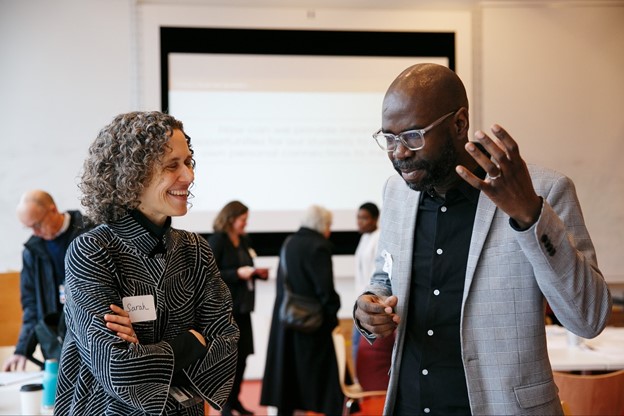
A woman and a man are conversing and collaborating in the foreground. The woman's arms are crossed and she is smiling, while the man is gesturing with his left hand in the air and looks to be in thought. Other people are conversing in the background. They all appear to be in a conference room.
Sarah Boyd Alvarez and Duone Brown, visual art teacher at Murray Elementary Language Academy in Chicago Public Schools, participate in an ideation session about using artworks to teach the theme of “Asia in the World”. The collaborative session included K-12 teachers, local scholars, curators, and museum educators.

I have so many more examples like this in my 20-year career and I won’t list them all, but these collaborations are something that only now I come to realize as a truly defining aspect of my work. These experiences have allowed me to see the relevance of object-based and art museum learning in so many contexts I had never previously imagined, although—and most importantly—they have never made me feel as if I was or needed to be an expert in each of those contexts. Instead, the work was so much richer because I partnered with people whose capacities were distinct from yet complementary to mine.

“Expertise” in Equitable Partnerships

Despite these examples of effective collaboration, I continue to see instances in our work as museum educators where we feel pressure to be all to everyone, which can feel like a constant reinvention of our professional selves. Colleagues in our museums or even audiences that seek us out unwittingly assume that when we are designing programs in response to important issues and events, museum educators must inherently become experts in that thing. For example, as calls for racial justice have increased and intensified, museums are embracing their role as spaces for dialogue, interaction, and change. As such, there is urgency among and for museum educators to learn and transform our practice to be one that is fundamentally antiracist. It can feel like we must become experts, and fast.

Rather than see this as a need to reinvent ourselves, however, I would posit that museum educators can always (and already do) seek to learn and grow our skills, perspectives, and understanding in response to the needs of our audience or time, and that we should continue to rely on our skills as collaborators with experienced partners to expand this effort. In fact, I want to make a case for museum educators to be more fully recognized for their skills in collaborating. In response to the world around them, they actively identify and seize opportunities to complement their experience and resources equitably with those of others and to truly create a whole greater than the sum of its parts.

I want to make a case for museum educators to be more fully recognized for their skills in collaborating.

Collaboration is one of the most unique and treasured qualities of museum education. And, in the case of antiracist pedagogy, it is essential to the ways we can contribute to dismantling the hierarchies and power dynamics associated with “expertise”. For instance, as a white woman of acknowledged privilege, whose formal education and training did not focus on antiracism, I embrace and commit to rigorously learning, reflecting, and transforming my practice, accepting that I will never be an expert since the work of antiracism is an ever-evolving fight against racism within changing contexts. My work as an antiracist educator will instead manifest in these various ways: at times teaching on my own while drawing from the lessons learned from observing others; in other instances partnering or co-teaching with peers who have different perspectives, skills, and experiences than I do; and sometimes fully stepping aside to let someone else take the lead. The “expertise” in this work will always be dynamic and situated within an equitable partnership, honoring the ways that the experience, knowledge, and perspectives of each contributor can elevate the teaching practice.

Such ongoing efforts to connect, learn, and create impact together with others are core to museum education. Museum educators’ “expertise” therefore isn’t singular, but rather contingent upon an equitable model of collaborative practice. As we navigate an ever-changing society and trajectory for museums, this approach to collaboration is truly our hidden strength and it deserves greater understanding and recognition. Who’s with me?

About the Author

Sarah Boyd Alvarez is Senior Director for Students and Educators in the Department of Learning and Public Engagement at the Art Institute of Chicago. She is responsible for a comprehensive program of learning resources and opportunities for K-12 schools, centering shared inquiry, cross-cultural connections, and accessible, multimodal experiences, with priority for Chicago Public Schools. In addition to her specific activities at the Art Institute, Sarah actively engages in city-wide dialogue about high quality, equitable arts education experiences for Chicago students and has published various articles and essays about museum learning. She can be reached at salvarez@artic.edu.

The post Collaboration, Expertise, and Museum Education: Reflections from a COVID-era Furlough appeared first on RK&A.
Written by cplysy · Categorized: rka

Jun 23 2021

Measuring policy advocacy

Monitoring policy work is tricky. But it doesn’t have to be. It’s not impossible – and certainly can be useful. Here is a proposal of how it can be done. We need a tool! This tool measures the extent to which an organization has influenced changes in policies. It can be used to monitor advocacy at the outcome level. The tool allows […]

The post Measuring policy advocacy appeared first on Dr. Thomas Winderl.

Written by cplysy · Categorized: thomaswinderl

Jun 22 2021

3 Common Reporting Hurdles—and How to Overcome Them

I work with a lot of different groups — government, universities, foundations, nonprofits, for-profits and many others.

One thing I’ve learned is that organization has a little bit different communication style.

Some groups are report-heavy. Think lots of paragraphs, portrait, Calibri size 11 turned into a PDF.  

Other groups are dashboard-heavy. They either have lots of static dashboards (short PDF reports) or lots of interactive dashboards and databases.

While other groups are presentation-heavy, kind of. They use PowerPoint, but they’re making standalone documents, not slides for presentations.

One thing these groups all have in common: Everyone has reports of one kind or another. And I often see three common report hurdles over and over again.

The Data Viz Today Podcast with Alli Torban

I recently spoke with Alli Torban on her podcast, Data Viz Today. Alli is an information design consultant who discovered data visualization while on maternity leave. She started the podcast as a way to grow and learn more about the data viz field.

She and I discussed those three common report hurdles we all run into and I gave solutions of how to overcome them.

Watch Our Conversation Here 

Challenge 1: Soaring Beyond the Dusty Shelf Report

The first common challenge I see is going beyond the report.

Most organizations have a report of some kind, but it’s hard to get into the mindset of a report AND a dashboard, slideshow, handout, etc.

In many workplaces, we definitely still need a report as one of our formats (e.g., grant reports that are required to be submitted at the end of a multi-year, multi-million-dollar project).

But our data can inform more decisions if we can offer a report plus other formats.

There’s often a misperception that it’s going to be time-consuming or costly to design a report and some other formats.

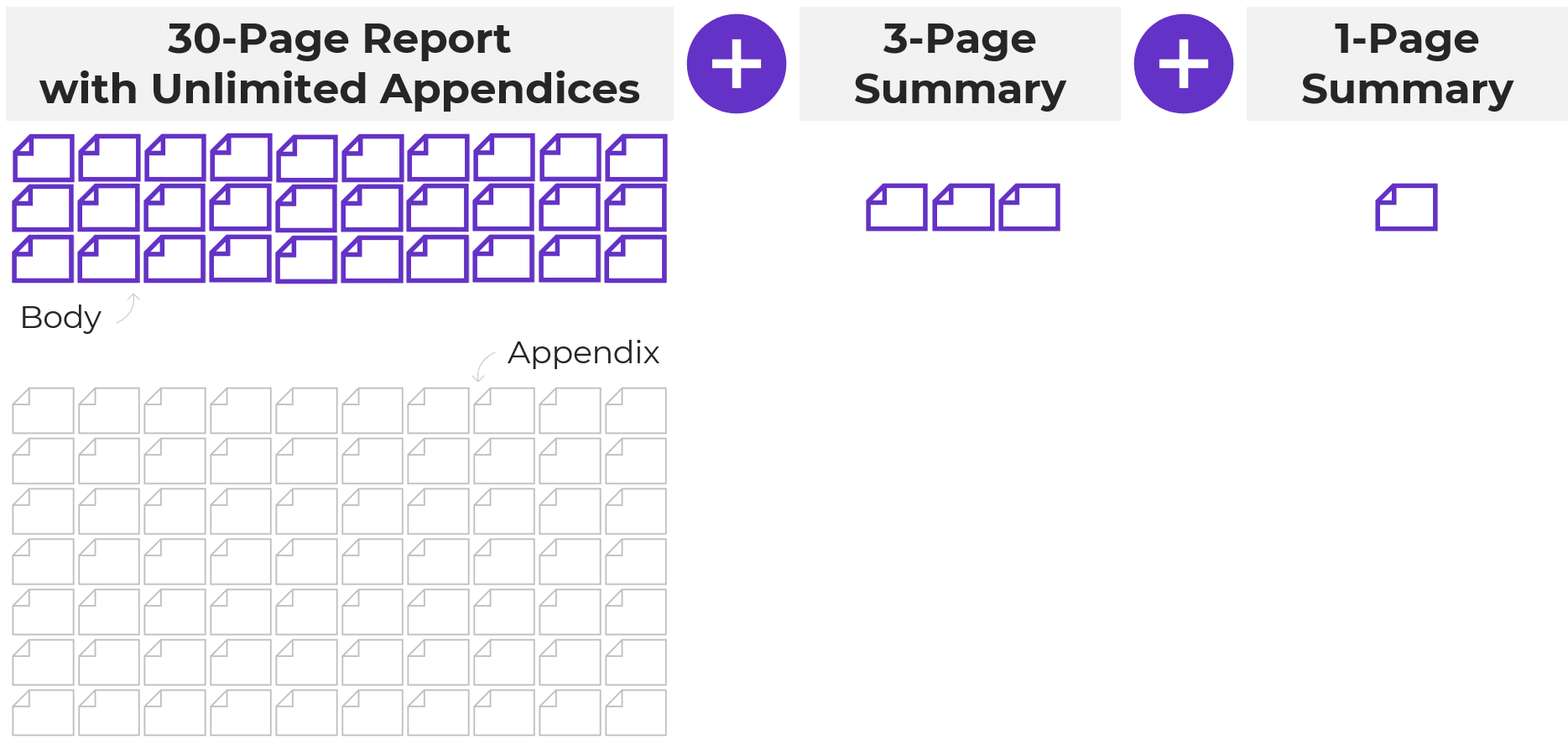
But, there’s a cost-effective and time-efficient solution: 30-3-1 with unlimited visual appendices.

The 30-3-1 approach is this: you take your dusty shelf report and you limit the body of the report to just 30 pages, the most important data. The rest of it doesn’t get deleted, you simply push it to back of the report in a visual appendix (which unlimited in terms of page numbers).

Then when you’re done with the 30-page report, you also make a 3-pager and a 1-pager. Each format will reach a different audience and will help your data reach more people and actually inform decisions.

The 30-3-1 approach: a 30-page report with unlimited appendices plus a 3-page summary plus a 1-page summary.

Not sure how to incorporate a visual appendix? You can learn more about how to start using this technique here: https://depictdatastudio.com/designing-visual-appendices-for-your-next-report-in-under-an-hour/

Challenge 2: Packing a Lot of Dense, Technical Information into a Report – Without Overwhelming Our Readers 

Another common challenge we all run into is needing to pack a lot of dense, technical information into a report—without overwhelming our readers.

I worked with a county to help create their 100+ page public health report card.

There was one page for each variable: traffic accidents, cancer deaths, pregnancy rates, environmental/ozone data, etc. Our challenge was to find a way to chunk all that data into a few categories that would make easier to read and navigate.

Our solution: Color-coding by chapter.

After categorizing the data, each chapter was designated its own different brand color.

The headings and visuals all used that brand color throughout the chapter (heading 1s, heading 2s, call-out boxes, sidebars, graphs, maps, bullet points, etc.).

The end result allowed readers to easily tell when a new topic began.

Your brain recognizes new color; the content must have changed as well.  

Color-coding by chapter lets your audience know that a color change means a new topic.

Here’s another example of when I worked with a university library to use color-coding to simply their report:  https://depictdatastudio.com/how-to-transform-a-text-heavy-report/ 

This technique can also be applied to slideshows, dashboards and infographics.

I use this technique when I give presentations as well:  https://depictdatastudio.com/visually-structure-your-presentation-around-key-points/

Challenge 3: Incorporating a Variety of Visuals—Not Just Graphs 

The final challenge I see are reports that are ALL narrative, or ALL graphs, or ALL photos.

We all tend to gravitate towards what we’re comfortable with but there are so many great types of visuals you can include.

In the video, you’ll hear Alli and I talk through this list of 15 visuals to include in our reports:

  1. Graphs 
  1. Photographs 
  1. Icons 
  1. Lists 
  1. Maps 
  1. Diagrams 
  1. Timelines 
  1. Logos 
  1. Screenshots 
  1. Text overlaid on images 
  1. Columns 
  1. Shapes 
  1. Handwriting 
  1. Cartoons 
  1. GIFs 
Using a variety of visuals in your reports helps to keep your audience engaged.

Your Turn 

I’d love to hear from you. What challenge have you dealt with (or are currently dealing with)? Which of these techniques have you use in your work? Comment and let me know.  

Connect with Alli 

Website: www.allitorban.com 

LinkedIn: @allisontorban

Data Viz Today Podcast: https://dataviztoday.com/ 

Written by cplysy · Categorized: depictdatastudio

Jun 21 2021

Evaluation Blogging

Dear Evaluator, I think you should blog.

Partially for selfish reasons.

The social world is undergoing fundamental changes that will shape our collective future.

As an evaluator you are positioned to observe those changes first hand. And I want to hear what you have to say. We all have unique perspectives and backgrounds, but it’s harder to hear you when you don’t speak.

But beyond that, blogging has been fundamental in guiding the path of my own career. As it has for some of my friends and colleagues. And I want that for you too.

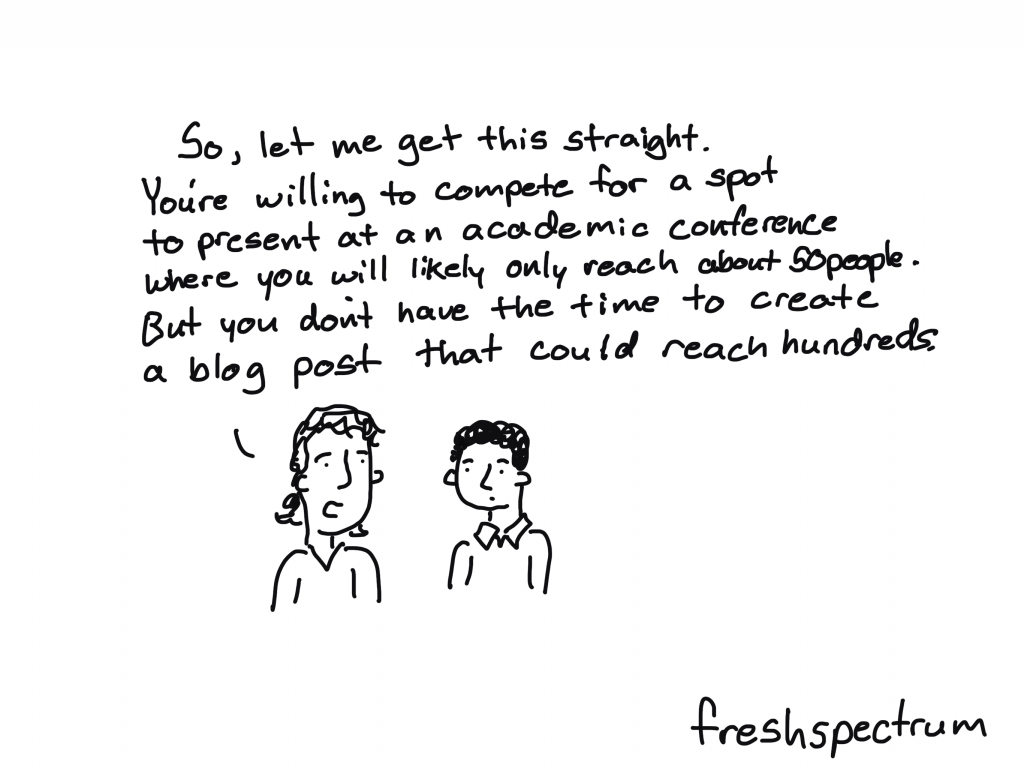
freshspectrum cartoon by Chris Lysy
"So, let me get this straight. You're willing to compete for a spot to present at an academic conference where you will likely only reach about 50 people. But you don't have the time to create a blog post that could reach hundreds."

In today’s post.

  • A little blogging advice…again?
  • Showcasing expertise in the digital era.
  • Blog the job you want, not the job you have.
  • Blogging as a resume booster.
  • Blogging as a network builder.
  • Blogging away the Google gaps.
  • Where are we now? Blogging tech in 2021.
  • Get an audience jumpstart by adding your evaluation blog to Eval Central.
  • This weeks’ awkward evaluation networking session with Isaac Castillo.

A Little Blogging Advice…Again?

This is certainly something I’ve talked about before. Over the last decade I’ve delivered conference presentations and written articles about the subject.

In 2013 I wrote a post pulling together blogging advice for researchers and evaluators from a group of 22 bloggers. Some are still blogging today on the same domains, some are blogging on new sites, and a few have stopped completely.

That post was this site’s most popular post for years. And I think the advice still rings true. It’s not 2013 anymore, there are more people sharing their views on the web. But don’t think for a second that your voice is not needed or that a blog can’t help you move your career forward.

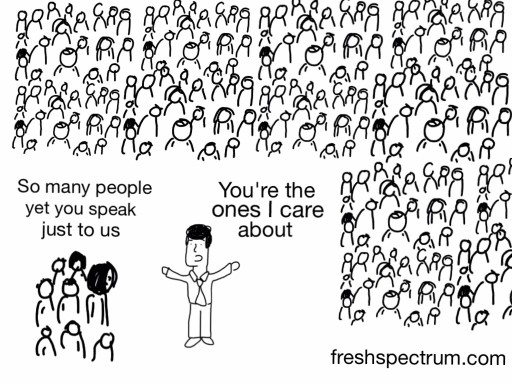
freshspectrum cartoon by Chris Lysy
"So many people yet you speak just to us."
"You're the ones I care about."

Showcasing Expertise in the Digital Era

All the world’s a stage,
And all the men and women merely players;

Opening lines from Shakespeare’s As You Like It

Fair or not, our professional first impressions these days are guided by what comes up on the other side of a Google search.

Your name could be on a series of important journal articles or listed as presenter alongside other big names at prestigious conferences. But if that stuff isn’t shared well on the web (associations and the academic publishing industry are not known for their web savvy) your reach will have its limits.

In the digital era, a blog is an amplifier. It can project your voice beyond the limits of the ivory tower. It’s the quickest way I know to change what people find when they search for you.

freshspectrum cartoon by Chris Lysy
"How do I get a job as an evaluator if my degree isn't in evaluation?"
"First thing to know. Most evaluators don't have evaluation degrees."

Blog the Job You Want, Not the Job You Have

On Wednesday of this week I’ll be chatting with Isaac Castillo about getting real world experience as an evaluator. It was that upcoming conversation that inspired me to write this post.

I hear from a lot of evaluators who want to know how to practice something like data visualization when you don’t have the opportunities at work. And my response is almost always to start a blog.

When I started blogging I was writing about new techniques, software, and visualization before ever having the chance to really apply the lessons through my position. Through much of the beginning parts of my career I would spend most of my time coordinating data collections, programming digital surveys, or following up with non-respondents.

It was only after I had shown what I could do through my blogging, that the creative opportunities started to present themselves.

Starting a blog gives you an opportunity to have something that you control. You get to call the shots on what you work on and what you don’t. Want to get practice creating infographics? Create a series of blog posts. Want to dive into R programming? Create a series of blog posts.

Let the professional you want to be guide your blogging. Don’t lie about your credentials, but don’t limit yourself to sharing only about your current paid work/past experiences.

freshspectrum cartoon by Chris Lysy
"This position looks interesting. Great organization, entry-level, and the role would be perfect for me. Oh, wait, they want 4 years of direct experience..."
"Not sure we're all on the same page with the meaning of the word entry-level."

Blogging as a Resume Booster

Want to show off a skill in your resume that’s not part of your current role?

Blog about it.

There is no reason that the publications section of your resume can’t include blog posts. Use that to your advantage.

When applying for a job, create a series of blog posts that align your experiences with the needs listed in a job posting. Not only will it improve your chances of being interviewed (since the posts will better align your background with the job posting) but it will also help you prep for a possible interview in the future.

freshspectrum cartoon by Chris Lysy
"So how did you two meet?"
"Well, we met when this guy sent me an email wondering if he could ask me a few questions for his blog."

Blogging as a Network Builder

The act of blogging can also help you build your network.

Want to reach out to someone you don’t know? Say a company you admire or an expert you would love to meet. Why not ask them if you can do a little interview for a series of Q&A blog posts.

You can bundle multiple interviews together into the same post or just take it one at a time. This also works well for independent consultants. Collaborating on a blog post with a potential client is a good, “non-salesy” way to get your foot in the door.

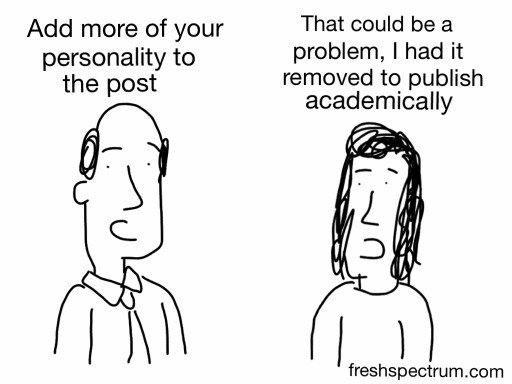
freshspectrum cartoon by Chris Lysy
"Add more of your personality to the post."
"That could be a problem, I had it removed to publish academically."

Blogging Away the Google Gaps

Do you have a specialty or area of expertise in the field?

What happens when you ask Google questions about your subfield? Do you like what you see or do you cringe at the search results?

Honestly, I believe we have an academic responsibility for the search results and

Wikipedia pages in areas for which we claim expertise. I have heard complaints that you shouldn’t trust a Google search to do your research. But complaints alone won’t increase the accessibility of good information.

Experts have agency. Don’t assume someone else will take the time to spread your work if you won’t take the time to spread your work.

freshspectrum cartoon by Chris Lysy
Blogging in the early years.
"Well, before you can start blogging you're going to have to learn some code. Start with HTML and CSS."
Blogging today.
"So to start blogging I have to register for an account and click a couple buttons."
"Yeah, it's a lot of work but it's worth it."

Where we are now, blogging tech in 2021

Blogging is easier than ever to get into.

The biggest tech platform for blogging is still WordPress. There are other platforms that let you blog, but WordPress is still definitely the leader.

If you hope to start regularly blogging, I suggest starting with WordPress.com. It’s free, and if you decide in the future you want more control over your site’s design, it’s easy enough to hire a developer and transition to a self-hosted WordPress.org site.

If you just want to write a blog post but don’t want to design a blog. You can do that right now for free using Medium.

You could also write an article using LinkedIn, but I recommend Medium because LinkedIn has a way of locking your post inside its social network. For example, I can integrate an author’s blog posts written in Medium into the EvalCentral feed. I cannot do the same with LinkedIn.

freshspectrum cartoon by Chris Lysy
"I know it's kind of nerdy, but I blog about evaluation."
"No kidding? Me too!"

Get an Audience Jumpstart by adding your evaluation blog to Eval Central

I created Eval Central about a decade ago as a tool to help evaluation bloggers reach evaluation audiences.

The site is basically a robot. Here is how it works.

  1. A blog gets added to the Eval Central “Feed”
  2. The blogger publishes a new post on their blog.
  3. Eval Central sees the new post (<1 hour of the original post) and creates a copy, with a link back to the original.
  4. The Eval Central version of the post gets automatically shared via social (Twitter, LinkedIn, Facebook). The @evalcentral Twitter account has the largest following among the different networks with over 4,500 followers as of June 2021.

Want your blog added (or want to suggest someone else’s blog) you can do that through my community site.

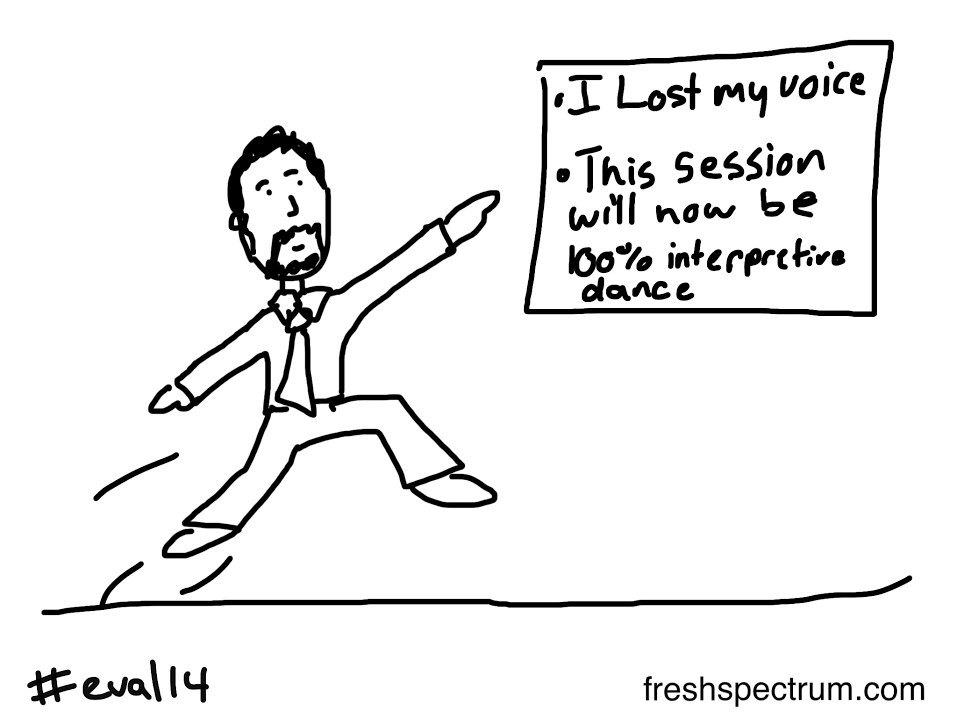
Fresh Spectrum cartoon showing a presenter pointing to a sign that reads "I lost my voice. This session will now be 100% interpretive dance."
Isaac is the inspiration (and star) of this cartoon.

This weeks’ awkward evaluation networking session with Isaac Castillo

For this week’s awkward evaluation networking (Wednesday at 2 Eastern)I’ll be joined by Isaac Castillo. The starter topic is about getting real world experience as an evaluator. It’s free, and should be a good conversation, hope you can join us.

Written by cplysy · Categorized: freshspectrum

Jun 21 2021

Evaluation is for everyone

A lovely green luna moth resting on a brick wall in the sun. Photo courtesy of my mother and appropriate for this moon power month.

A lovely green luna moth resting on a brick wall in the sun. Photo courtesy of my mother and appropriate for this moon power month.

What a time to be alive. Back when we could still gather in groups to sing together, that was a lyric from a song I loved in the drop-in choir group I sang with every week. It is time now, and what a time to be alive.

Yesterday was Juneteenth. Tomorrow is National Indigenous Peoples Day. It’s the height of Pride season. It’s the summer solstice. It’s the first day of Cancer season. There’s a full moon in Capricorn on Thursday, which is also the Strawberry Moon, which is also the last supermoon of the year. Somewhere in there it’s also going to be my 35th birthday. And we are still living within crisis within crisis within crisis within crisis within crisis. What a time to be alive.

I mark the passing of time with reflection. I love to skip back through my calendar apps and my photo albums and remind myself where I was, what I was doing, what I was thinking about and trying to get done a month ago, a year ago, a decade ago. I realized yesterday that I have just passed the ten-year mark of being an evaluator.

Ten years ago last month, I began leading my first evaluation project. Still a grad student at the time and would be for another couple of years, but that was the real threshold for me. That was the moment I stepped into the role of evaluator and took on that responsibility. The work I started doing then had all the portents and shades of what I would spend the next ten years plus trying to realize in my practice. I wanted to do work that was meaningful, helpful, accessible, and exciting for people pouring their hearts into transforming their corner of the world.

It’s not yet quite the three year anniversary of when I felt truly inspired in how to do that. Three years ago, in September 2018, when I took a course called Transformative Evaluation Landscape from Kim Van Der Woerd, Sofia Vitalis, and Elders Lillian Howard and Roberta Price, and with a cohort of peers experienced for the first time a complete immersion into a space where we were asking each other and ourselves, why are we evaluating, who are we evaluating for, and according to whose values and worldviews?

I’ve told that story many times, but I don’t think I’ve shared yet the phrase that got stuck in my head and my heart by the end of that course, that I’ve been carrying ever since. I’ve realized that this phase is the thesis statement of my practice journey, my theory of change, my core principle. Evaluation is for everyone.

It took me over a year to even unpack what that sentence means to me. Evaluation is for everyone. I didn’t know what it meant in my head so much as I felt it with the certainty of my whole body. Evaluation is for everyone. That is the beating heart of my practice.

Evaluation is for everyone

means that evaluation is supposed to serve everyone. Not just the people with the money. Not just the people with the power to set policy. The power dynamics in evaluation are intense and so much of the decision-making revolves around appeasing and appealing to those with a very specific kind of power. Rarely have I seen the energy expended on engaging and satisfying funders matched with what will engage and satisfy the people directly impacted by the program and the evaluation. This is a systemic issue, not the fault of individual organizations and people trying to keep their work alive and funded, but as evaluators we play into it and collectively seem to have resigned ourselves to it being an inevitability. I remember getting into a Twitter dust-up with someone who argued that the people with the money ultimately should get to decide what they do with that money, and evaluation therefore is there to serve them first and foremost. Others out there have already done the work of unpacking a statement like that, including Edgar Villenueva in Decolonizing Wealth and the entire Equitable Evaluation framework, so I’ll mostly leave it at that, but I will also add that being able to pay for evaluation and then having evaluation influence funding is an embarrassingly obvious “success to the successful” system trap that we should be a lot more concerned about as an equity issue in evaluation. Evaluation cannot serve equity when it is extractive, taking data from some to generate recommendations and reports for others, and when it uncritically reinforces and upholds the inequitable distributions of power already present.

Evaluation is for everyone

means that everyone can and does do evaluation. Everyone is an evaluator. Evaluation is a fundamental human behaviour of learning from experience and making judgement calls based on what you were trying to do, what happened, and what you want to happen next. When I do evaluation capacity-building work, I always come from the standpoint of, “You already know how to think and work this way, you do it all the time; I’m going to offer some language and framing so that we can talk about how we’re doing it together, do it more intentionally, and feel more confident and less lost”. There is nothing about evaluation that requires a technical degree or a particular credential. I became a professional evaluator when I started doing paid evaluation work and I brought to that a host of skills and life experience I had acquired up to that point, only a subset of which came from formal evaluative training (and only a subset of that training was ultimately useful to me as a practitioner). To be a professional evaluator is to step into the responsibility of a particular role in a project (which is not always the role we think it is), but it is not to lay exclusive claim to what evaluation is as an essential human endeavour. I have never once entered a project as an evaluation consultant and found that no evaluation was happening. People are already in there, working with the data they have, using the critical and creative evaluative thinking that comes naturally to them, generating, refining, implementing, and adapting their theories of change. The quality and utility of my work increased vastly when I stopped doing evaluation like a social science researcher, mediating and creating knowledge for people, and started doing it like a participatory facilitator, hosting the spaces and opportunities for people to create the knowledge they need to do their work better and recognizing their inherent capacity and capability to do that.

Evaluation is for everyone

means that evaluation needs everyone to be part of it. It’s for all of us to do together. We can evaluate as individuals and reach individual conclusions and choices, but when the change requires collective work, our evaluation must also be collective. The things we are struggling with are huge, bigger than we can address on our own or with individual programs and organizations. For evaluation to be more than an institutionally-mandated surveillance-and-compliance exercise and to not get stuck in a space of organizational navel-gazing and toxic intellectualization, we have to notice and challenge our individualistic approaches to evaluation. This is difficult, in no small part because our funding models and the dominant cultural frameworks we’re all being forced to work within reinforce individualism at every step. But every evaluation we do is a chance to see the paradigm we’re in and look for opportunities to play with it, subvert it, push back on it, and imagine something different. What would it change about our work if we entered it with the fundamental belief that evaluation is a collective, communal act? That it’s not enough to circulate reports and products after the fact, but that the process, the evaluative act itself, belongs to and depends on a community of people invested in a change and a state of being in the world? That this is not a niche form of evaluation appropriate to special circumstances but reflective of a worldview and a belief that we deserve to live in systems that are arranged to respect our agency and our interdependence.

Evaluation is for everyone. Put it on a t-shirt.

Happy solstice, friends.

Written by cplysy · Categorized: carolyncamman

  • « Go to Previous Page
  • Go to page 1
  • Interim pages omitted …
  • Go to page 178
  • Go to page 179
  • Go to page 180
  • Go to page 181
  • Go to page 182
  • Interim pages omitted …
  • Go to page 310
  • Go to Next Page »

Footer

Follow our Work

The easiest way to stay connected to our work is to join our newsletter. You’ll get updates on projects, learn about new events, and hear stories from those evaluators whom the field continues to actively exclude and erase.

Get Updates

Want to take further action or join a pod? Click here to learn more.

Copyright © 2026 · The May 13 Group · Log in

en English
af Afrikaanssq Shqipam አማርኛar العربيةhy Հայերենaz Azərbaycan dilieu Euskarabe Беларуская моваbn বাংলাbs Bosanskibg Българскиca Catalàceb Cebuanony Chichewazh-CN 简体中文zh-TW 繁體中文co Corsuhr Hrvatskics Čeština‎da Dansknl Nederlandsen Englisheo Esperantoet Eestitl Filipinofi Suomifr Françaisfy Fryskgl Galegoka ქართულიde Deutschel Ελληνικάgu ગુજરાતીht Kreyol ayisyenha Harshen Hausahaw Ōlelo Hawaiʻiiw עִבְרִיתhi हिन्दीhmn Hmonghu Magyaris Íslenskaig Igboid Bahasa Indonesiaga Gaeilgeit Italianoja 日本語jw Basa Jawakn ಕನ್ನಡkk Қазақ тіліkm ភាសាខ្មែរko 한국어ku كوردی‎ky Кыргызчаlo ພາສາລາວla Latinlv Latviešu valodalt Lietuvių kalbalb Lëtzebuergeschmk Македонски јазикmg Malagasyms Bahasa Melayuml മലയാളംmt Maltesemi Te Reo Māorimr मराठीmn Монголmy ဗမာစာne नेपालीno Norsk bokmålps پښتوfa فارسیpl Polskipt Portuguêspa ਪੰਜਾਬੀro Românăru Русскийsm Samoangd Gàidhligsr Српски језикst Sesothosn Shonasd سنڌيsi සිංහලsk Slovenčinasl Slovenščinaso Afsoomaalies Españolsu Basa Sundasw Kiswahilisv Svenskatg Тоҷикӣta தமிழ்te తెలుగుth ไทยtr Türkçeuk Українськаur اردوuz O‘zbekchavi Tiếng Việtcy Cymraegxh isiXhosayi יידישyo Yorùbázu Zulu