• Skip to main content
  • Skip to footer
  • Home

The May 13 Group

the next day for evaluation

  • Get Involved
  • Our Work
  • About Us
You are here: Home / Archives for allblogs

allblogs

Jun 18 2021

Anti-racism Pledge: 7-month Update

Seven months ago, RK&A committed to anti-racist practice. To hold ourselves accountable, we write these updates to publicly document the work we have been doing and work still to do.

We at RK&A, individually and collectively, pledge our commitment to being anti-racist—which we recognize as an ongoing pursuit through our everyday actions.

“Being racist or antiracist is not about who you are; it is about what you do.”

—National Museum of African American History and Culture’s Talking About Race website

Regular and Deeper Internal Discussions on Anti-racist Practices

Anti-racist practice is an agenda item at every staff meeting, so the work is top-of-mind.  We document and share what we have been reading related to anti-racist practices.  We reflect on anti-racist practices in our current work.  Also, we set goals for anti-racist practices for future work.  As RK&A staff, we have been working together for 5 years or longer. There is a great deal of trust among us, so our conversations are open and vulnerable.  We don’t always have solutions or the right words to talk about anti-racist practices.  But, we have a safe space to do the work together, which I value.  I think it helps us build the confidence to apply anti-racist practices in our client-facing work.

Our conversations about anti-racist practices are not relegated just to staff meetings.  For example, staff recently witnessed the way language and actions can cause harm to people of color during a recent project meeting.  They brought this experience back to the whole RK&A team.  We talked about what happened, and how the project partners of color responded.  We also discussed potential ways we might anticipate and handle similar situations in the future.

Using Anti-racist Language in Public-facing Situations

In RK&A’s public-facing work, we have grown comfortable using anti-racist language.  Speaking for myself, I try to be clear about the value I place on anti-racist practices.  I am still not very confident in my anti-racist practice though.  And, I am sure I make mistakes in both anti-racist and inclusive language. (For example, in trying to lay out the biases of a homogeneous group in a conversation with colleagues, I used the term “heteronormative” incorrectly.  I did not mean to say the group believed heterosexuality was the preferred orientation).  When I doubt myself, I like to revisit the National Museum of African American History and Culture’s Talking About Race website. It helps remind me to keep doing the work.

Work To Do

It is intimidating to acknowledge that anti-racist work is never done. Anti-racist practice is not a competence to be mastered but a constantly evolving practice.  In the next few months, we will continue to reexamine our evaluation and research practices with our new understandings of anti-racist practices.  In our commitment to anti-racist practices last year, we committed to systematically examine our work using We All Count’s Data Equity Framework.  We did this to some extent at the time of making this pledge.  But, we and the world have changed since then.  It is time to take stock again of where we are and where we want to go.

The post Anti-racism Pledge: 7-month Update appeared first on RK&A.

Written by cplysy · Categorized: rka

Jun 16 2021

Illuminating Culture and Nature Equally: Generative Thinking at a Critical Time

By: Emlyn Koster

Spurred by the art-dominated sections on Museums in The New York Times, Emlyn reflects on this sector’s pressing need for a balanced profile between people/society and non-human life/nature.

Eminence of Art Museums

Titled ‘Reinventing the Future,’ the May 23, 2021 Museums section of The New York Times reveals its bias with this front-page statement: “As museums emerge from a devastating pandemic, they are seeing their art and their purpose in a new light”. Art museums dominate its 30 pages. Two-thirds were occupied by ads for exhibits and stories about art museums: the other third comprised exhibit ads and stories about the American Museum of Natural History (AMNH) and New York Historical Society with a miscellany of articles about Black Lives Matter, Indigenous, and other pressing civic matters. I also reviewed the 40-page Museums section on March 13, 2020. Two-thirds were ads for art and photography shows with the rest featuring exhibits in history museums about colonization, oppression, racism, immigration, and tolerance, plus there were half-page reports about coverage of the 1918 flu pandemic at Philadelphia’s Mütter Museum and climate change at the AMNH.

Astonishingly, the art museum dominance of the May 23 section was accentuated by its opening Critic’s Notebook titled ‘10 Ways for museums to survive and thrive in a post-Covid world’: 26 of its 28 cited institutions are art museums. Three days later, this unbalanced picture was reiterated in an opinion, ‘Still searching for the reimagined museum,’ by a Canada-based museum consultancy lauding the Critic’s Notebook article as if it had provided insights for museums of all types. With repeated admiration for a virtual program from The Frick Collection and concern over a partnership between the Canadian Museums Association (CMA) and Canadian Heritage towards a federal policy for museums, it criticized a perceived lack of impact by Canada’s museums as if their national association determines programs at member institutions. On International Museums Day on May 18, the CMA’s public statement wisely concluded: “The pandemic has changed society. For museums to continue serving the Canadian public, new paradigms, approaches, and solutions must be formed”.

In many quarters, the arts and culture are regarded as equivalent despite early and ongoing efforts to also elevate science into the realm of mainstream culture. Indeed, it remains common to encounter publications and news stories with titles implying broad coverage of the museum sector but which are mostly or only about art museums. While full- and half-page ads understandably help to finance the Museums sections in The New York Times, it would be useful to enlighten readers, while they are drawn to the sector as a whole, about issues such as monetization of artworks, relevance to contemporary matters, and internal stresses with changing priorities. Surely the masthead slogan on every edition of The New York Times―”All the News That’s Fit to Print”―should include a commitment to impartiality about museums!

Generative Thinking

This practice fills an important gap when the initial scope of considerations falls short of all pertinent realities. I came across this approach a decade ago in a Harvard Business Review newsletter contribution by Manda Salls: “… it’s the way in which the intellectual agenda of the organization is constructed… the question should be ‘… do we have the problem right?… generative thinking is getting to the question before the question… it’s not about narrow technical expertise.” A 2015 article adds: “It is a way… to examine an issue or an idea by generating more information about it: identifying the problem instead of solving it; generating questions instead of answers; and making sense before making any decisions”. On the premise that asking topical questions has become an essential activity of museums, I invite a comparison of the list of ten content suggestions offered by Jason Farago in the Museums section of The New York Times with the list of ten progress indicators in my AAM-invited 2006 article about increasing museum relevance and sustainability.

Last year as the pandemic began, I joined an online discussion featuring the Museum for the UN and International Coalition of Sites of Conscience. A participant from Mexico seemed to capture everyone’s attention when he said: “… answering questions is evolutionary but asking new questions is revolutionary.” For me, this reinforced the breakthrough caliber of the question-asking exhibition titled “Race: Are We So Different?” which I hosted at Liberty Science Center and the NC Museum of Natural Sciences (summative reports on the NC experience are available as email attachments from me). With society plagued by systemic racism, this exhibition performed a vital public service by drawing attention to the biological fact that all of human variation amounts to just one tenth of one percent of human DNA. I wish that designing and titling exhibitions with a socially or environmentally pressing question became a common approach.

Nature and Culture

Unbalanced news coverage of the museum sector is more than unfortunate: it warrants a revolution of the questions being asked. As a scientist before a museologist, one of my vantage points in pondering the perilous state of the world is that Homo sapiens, us, the human species, is one of 1.2 million described species and as many as a yet-to-be-described additional 8.7 million species. Society’s emphasis on culture over nature is apparent in the popular use of diversity as distinct from the term biodiversity which respectively refer to human variation and to all of genetic variation across the plant and animal world.

A tall, modern looking museum building emerges out of the rainforest.
Rendering of Xinatli, a planned research museum in the Mexican rainforest. (Source: Studio Viktor Sørless)

Mary Ellen Munley’s review of a book about the social work of museums observed: “… museums are being noticed for the ways they can foster cultures of caring — people caring about each other; people caring for the planet”. Spurred by visionaries such as Jane Goodall, more of society has come to respect non-human life, especially sentient non-human life, and to view natural environments in a complete ecological light. A new museum project in Mexico offers a refreshing prospect of tackling some vital questions about the biosphere. Named after the Nahuatl word xinachtli which describes the moment a seed germinates in the soil, its mission is to utilize “art and aesthetic perception, an ecologically oriented way of building, and a cultural engagement with the other to help preserve the permanence of all life on our planet”.

In the vast majority of natural history and natural science museums, Earth history stops before Homo sapiens evolved. For many institutions, an actual or fake mummy is the extent of coverage of human development as opposed to overviews or samples of the results of fundamental inquiries central to all of us. These include the fascinating developments of rituals, language, religion, shelter, clothing, agriculture, aquaculture, communities, hierarchy, exploration, trade, technology, and conflict. This is an example of the need for the museum sector―and The New York Times―to ask new questions. In the Anthropocene, social justice and environmental justice are interconnected movements.

About the Author

Emlyn Koster, PhD is a geologist, museologist and humanist focused on the Anthropocene, an emerging new age in the Geologic Timescale to recognize humanity’s disruption of the Earth’s natural state and biodiversity. A former chair of the Geological Association of Canada and now an adjunct professor of Marine, Earth and Atmospheric Sciences at NC State University, he has been the CEO of the Royal Tyrrell Museum of Palaeontology, Ontario Science Centre, Liberty Science Center, and the NC Museum of Natural Sciences. He can be reached at koster.emlyn@gmail.com.

The post Illuminating Culture and Nature Equally: Generative Thinking at a Critical Time appeared first on RK&A.

Written by cplysy · Categorized: rka

Jun 15 2021

Data Placemats: A 3-Step Process for Increasing Data Use

Want to make sure that your data gets used to inform decisions?

Get your stakeholders involved in the sense-making process!

Are you familiar with data placemats?

Here’s how they work:

  1. Design Data Placemats
  2. Facilitate an Interpretation Meeting
  3. Include those Insights in the Final Report or Slideshow

Step 1: Design Data Placemats

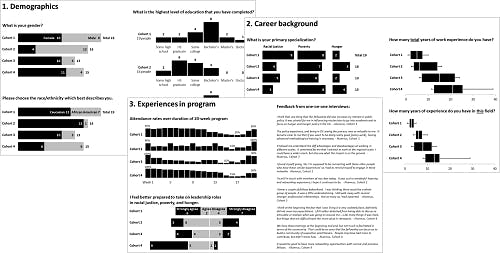
First, we analyze the data and display key findings in data placemats. You might display survey responses, for example.

These placemats should include traditional graphs. That means the graph titles contain the topic area, not the takeaway finding, and there’s no color contrast. Imagine a bar chart where every bar is the same color, so that nothing stands out. It’s up to the viewer to figure out the “so what?” for themselves.

We can make data placemats in any software program. You know I’m a champion for everyday software. PowerPoint’s my top choice for data placemats because it’s easy to arrange multiple graphs on the slide.

Your placemats might look like this, with one page per survey topic.

Step 2: Facilitate an Interpretation Meeting

Next, we gather people together, either virtually or in-person.

During the meeting, we’re facilitators, not lecturers.

It’s a conversation, not a presentation.

We ask questions like:

  • “What surprises you about the data?”
  • “What factors might explain the patterns we’re seeing?”
  • “What additional questions do you have?”

The goal is to get attendees to verbalize the takeaway findings in their own words. We listen, listen, listen.

Step 3: Include those Insights in the Final Report or Slideshow

Finally, we go back to our offices and create a final deliverable for the project, like a report or slideshow (if needed).

The final version should include storytelling graphs, which means the graphs have the takeaway findings in the graph titles, and include color contrast. Imagine a bar chart where everything’s grayed-out except for the one important bar in a darker color.

The interpretation meeting becomes a data collection event; we quote the meeting attendees and include that qualitative data in the final report.

This process not only gets stakeholders involved in the process–making it more likely that they’ll use the findings–but makes the final report or slideshow even richer.

Learn More

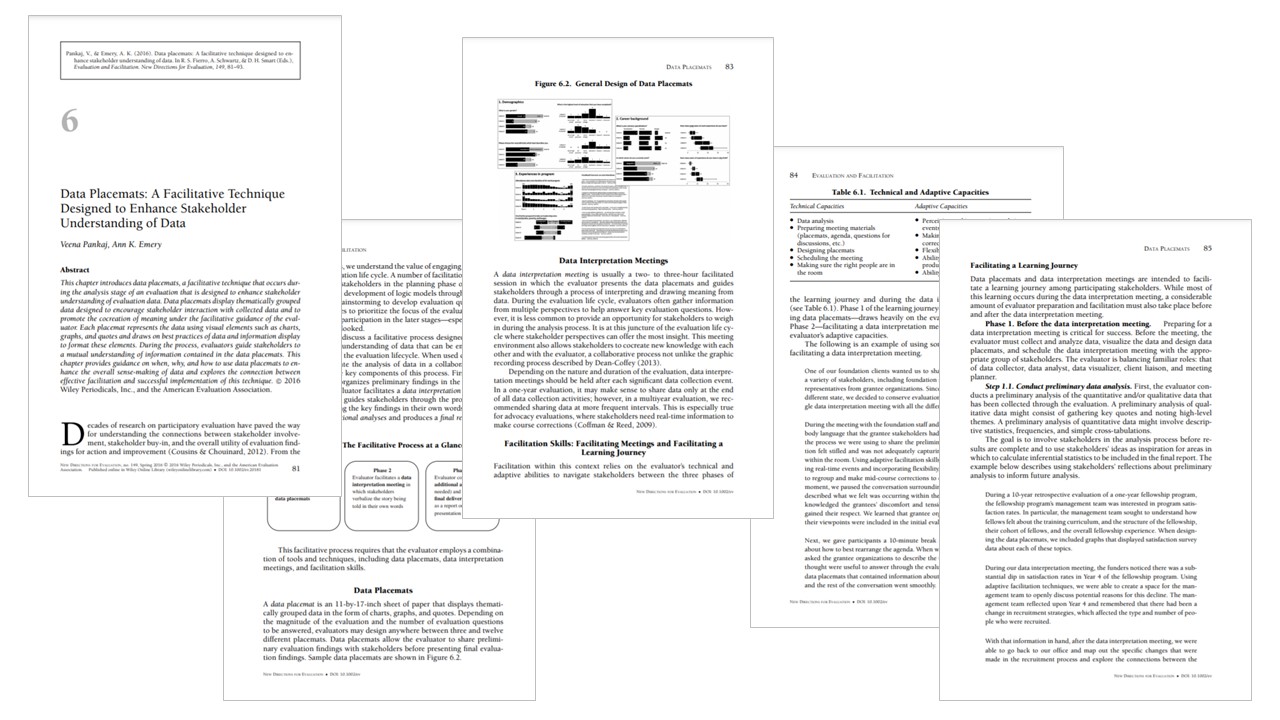
I learned this technique years ago from Veena Pankaj. Veena and I published an article about placemats together that you read can here: https://onlinelibrary.wiley.com/doi/pdf/10.1002/ev.20181

Your Turn

Have you used data placemats in your project? Comment and share tips of your own!

Written by cplysy · Categorized: depictdatastudio

Jun 15 2021

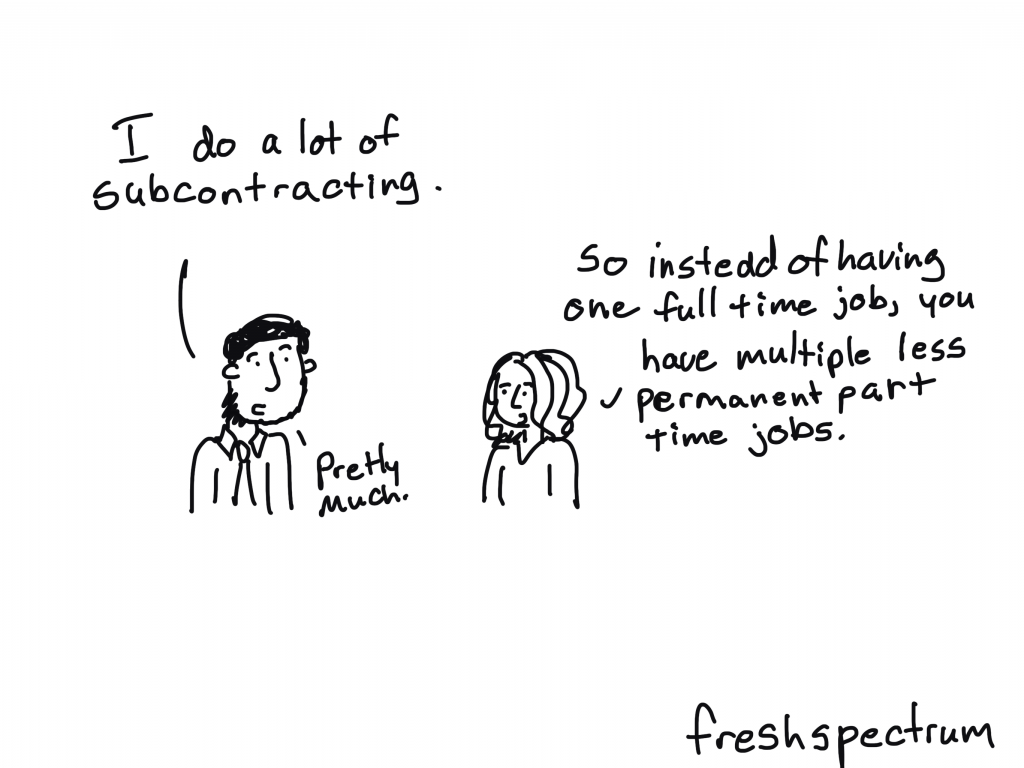
Evaluation Subcontracting Business Model

Have you ever noticed how the large well-known consulting firms seem to consistently get the biggest contracts. How is a small business even supposed to compete?

Maybe you’re not. But if you can’t beat ’em, join ’em.

In this post:

  • Why the big companies tend to get the big contracts.
  • The subcontracting business model.
  • What are small business set asides and how do you specialize your services.
  • How to follow the money and search for existing contracts.
  • Rates, contract types, and other contracting things.
  • Preview of this week’s awkward evaluation networking session.

Why big companies get the big contracts?

You don’t get fired for hiring IBM.

Quoting one of my mentors, she adapted this from an IT industry catch phrase, “Nobody ever got fired for buying IBM.”

Let’s say that two experienced IBM employees decided to leave their positions and start a consulting business. Their idea was to offer consulting, the same thing they did for IBM, but for half the cost of what IBM would charge. In their minds it was a win win. They make more money and the client spends a lot less.

Same people, less money, win, win, right?

Except here is the problem. For the person hiring the consultants there is a big difference between hiring IBM to do the work and hiring two people who used to work at IBM.

As a former mentor of mine would say, “you don’t get fired for hiring IBM.”

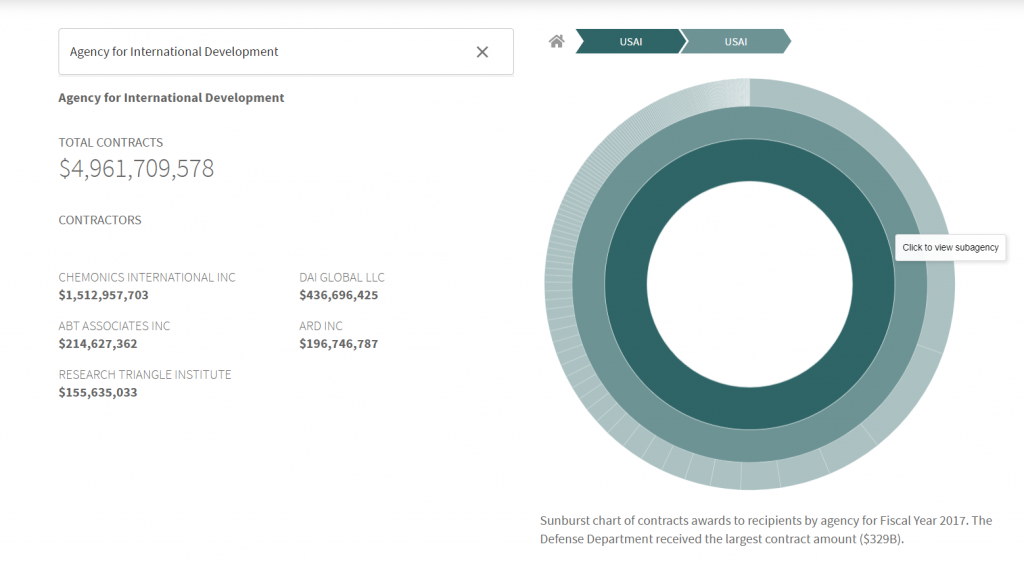
One contractor, Chemonics International Inc, received 1.5 billion dollars, over 30% of USAID’s contract awards in fiscal year 2017.

There is a reason that big consulting firms tend to win the big contracts. The client, let’s say the federal government, knows that if they choose one of their reliable steady partners, the work will get done. It might not be cutting edge and you could possibly get the work done cheaper elsewhere, but if your principal investigator retires, or the programmers quit, you know the positions will get refilled and the work will get done.

So this leaves you, as a small business person, with a choice.

You could fight the big competitors by pulling together an all start team and taking your best shot at a bid on that large federal contract.

Or, you partner with the big organization who has already shown they can win this kind of big contract.

The Subcontracting Business Model

Be the remora, not the shark.

As an indie consultant or small business, you don’t need to win big contracts on your own to make enough money in the consulting world. Sometimes you don’t even need to participate in the proposal writing, just lending your name, bio, and resume can be enough if it adds something to the bid.

A successful subcontracting business model usually involves two things.

  • Being Special
  • Being Known

Let’s talk about how to do that.

What are small business set-asides?

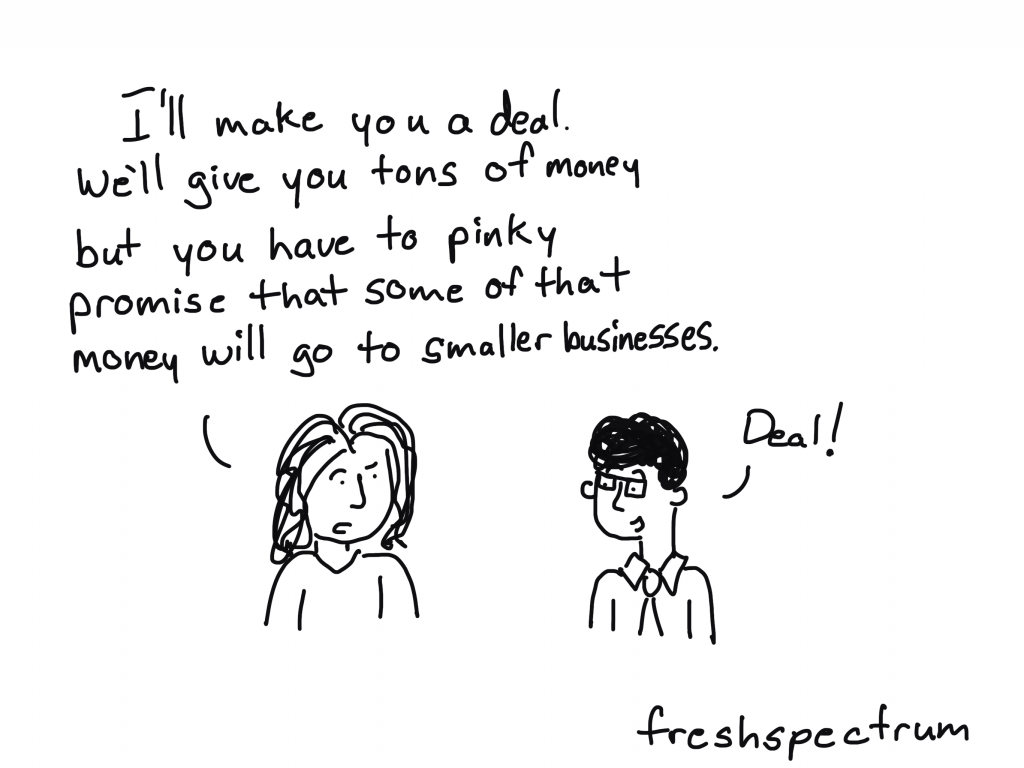
The federal government prefers to contract with small businesses whenever possible. Contracting officials can use set-aside and sole-source contracts to help their agencies meet their small business contracting goals.

How you should offer a contract will depend largely on two factors:

>The number and type of small businesses that are able to do the work
>How much the contract is worth

Set-aside Procurement from the SBA

The federal government does hire a lot of big companies to do their work. But that doesn’t mean that there is no support built into these contracts to assist small businesses.

Small business set-asides are designed to push government agencies to work with smaller contractors. In addition to opportunities designed specifically for bid by small businesses, requirements are also built into larger cooperative agreements. Those larger contractors need to meet their small business set-aside numbers or face penalties.

Also, all small businesses are considered in the same way. Generally there are six federal classifications for small businesses.

Small Business (SB), Small Disadvantaged Business (SDB), Women-Owned Small Business (WOSB), Historically Underutilized Business Zones (HUBZ), Service-Disabled Veteran-Owned Small Business (SDVOSB), and Veteran-Owned Small Business (VOSB). If you want to do business with the federal government, and any of that is you, you can register at the SAM website.

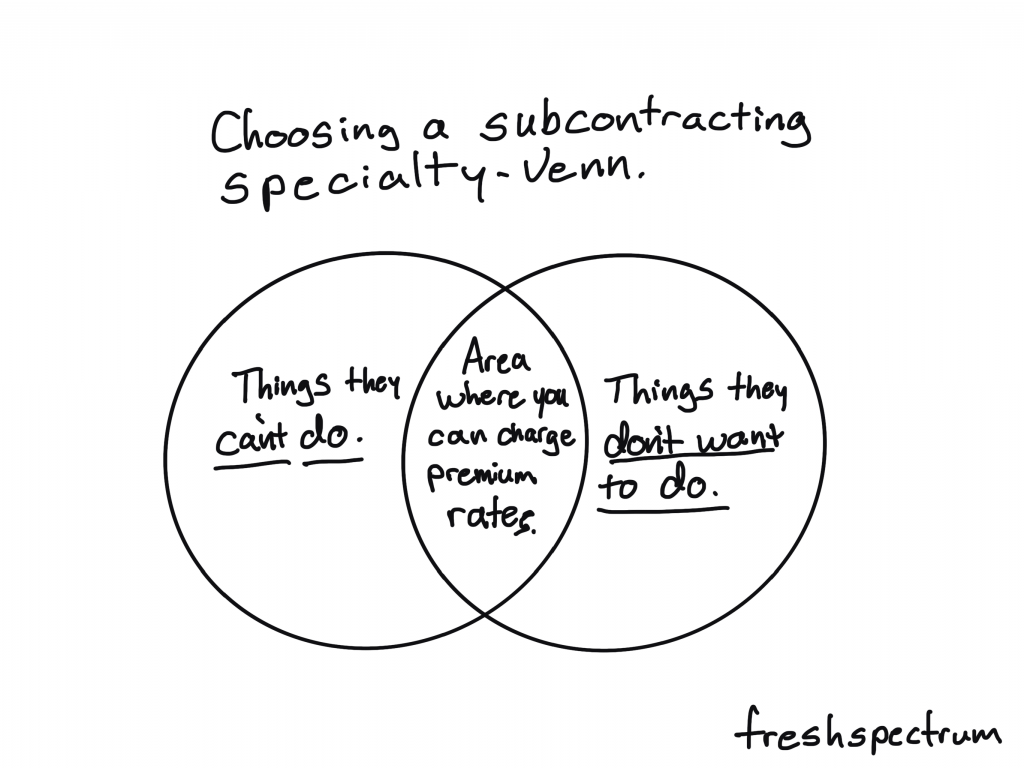
How to specialize your services.

Even the biggest consulting organizations have plenty of skill gaps.

Your best approach to securing more subcontracts is to offer something that the big organization cannot. Or offer something that the big organization does not have an interest in doing.

In my own work I tend to focus on services that fall into the overlap between design, tech, and evaluation. In larger organizations research/evaluation program staff, IT staff, and design/communications staff work out of different silos. If a project requires IT, you reach out to the IT team. If it requires design, you reach out to the design team.

But where they get thrown off is when something requires a mix of design, IT, and evaluation expertise. All of a sudden you need a room full of people to do what would be a simple project for someone like me. Plus, that room full of people can be filled with egos and occasional infighting because of office politics.

Sometimes an organization will subcontract, not because the organization doesn’t have the skill set (or a desire to develop the skill set) but because they would rather work with the people in the partner organization than certain people in their own.

Following the money and making new friends.

Lots of large consulting organizations have small business liaisons and offer partner applications on their websites (here is one for the aforementioned Chemonics). If you know you might want to work with an organization, you should know the liaison and put in a partnership application.

From my experience, I find it’s better to know the actual people doing the work that you would like to support. Making direct connections with people who run funded projects or people who bid on (and win) the kinds of projects you would like to support.

It’s easier to get paid consistently as a subcontractor if you can make yourself part of the original project bid. This requires relationship building, and collaboration. Use targeted networking strategies to get in front of the right people.

Exploring contract wins.

The federal government spends about $500 billion each year on contracts – that’s roughly the size of Sweden’s economy.

Ever wonder who’s getting federal contracts and what agencies are awarding them? This tool lets you explore contract-related information for FY 18, including which organizations received federal contracts, contract amounts, awarding agencies and sub-agencies, and the types of goods or services contract recipients provided to the federal government.

Contract Federal Explorer – USASpending

The good thing about federal spending is that there is a public paper trail.

You can find loads of information about the organizations receiving federal money through search at usaspending.gov. Through keyword searches you can find awards that match the type of work you support.

Once you find an interesting contract, go further and search some of the special numbers you’ll find, like the Procurement Instrument Identifier (PIID). Not only will you be able to find out what awards an organization receives, but how it plans to do the work, and how much it plans to pay it’s staff for different objectives.

Rates, contract types, and other contracting things.

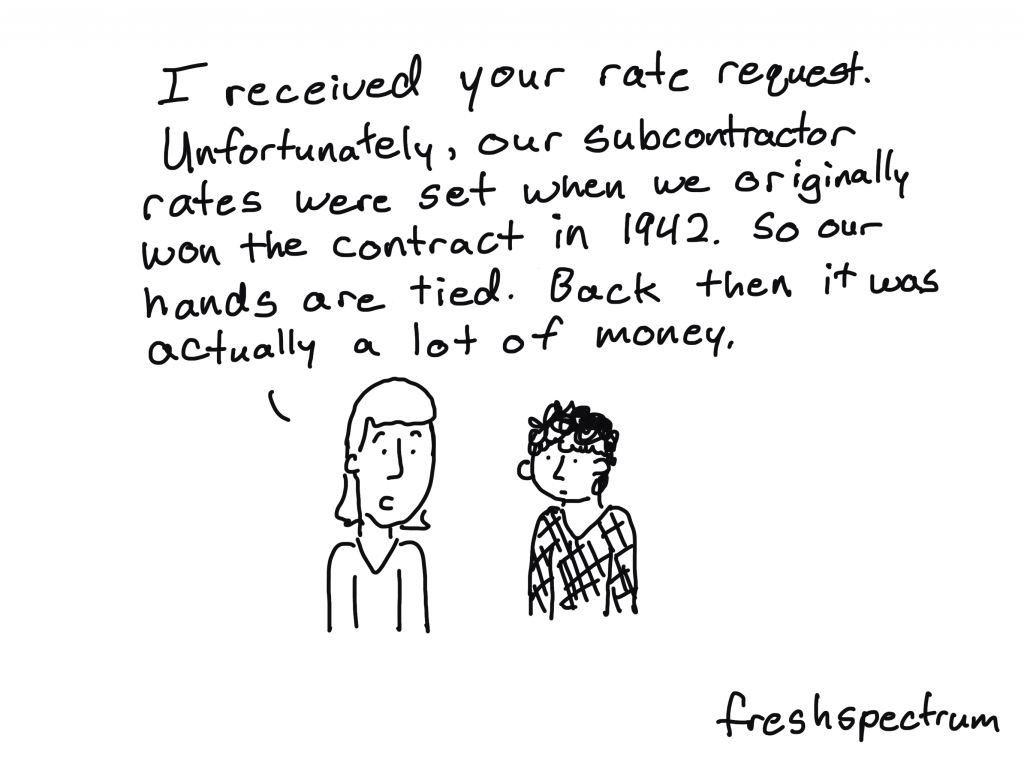
When working on Federal government contracts, some of your possible rates are going to be based on certain bureaucratic pay tables. This can limit some of your leverage as a professional, but it can also make your rate setting easier.

If your work requires travel, make sure to check out the GSA’s per diem rates.

There is a lot to learn when it comes to federal contracting. You don’t need to know it all to work as a subcontractor, but being informed about the type of contract/pay structure can certainly help you decide how target your services.

This week’s awkward evaluation networking session.

Join us for this week’s awkward evaluation networking session, on Wednesday, June 16 at 2PM Eastern. There is no featured networker this session but we do have a starter topic.

This week’s starter topic: Evaluation Subcontracting

You can register for the series and RSVP for the session, here: https://evaluationworkshops.com/p/evaluation-networking

Written by cplysy · Categorized: freshspectrum

Jun 15 2021

Looking for the “So What?” In Our Data

Looking for the “so what?” in our data

If you’ve read this blog for any period of time, you’ve probably figured out that data tracking is kind of my thing. 

My super Type-A personality gets a lot of satisfaction from crossing every “t” and dotting every “i” and making sure that I can quickly access all of the data at my disposal in an organized, visually-appealing way. 

I started my business largely because I saw that many school-based staff struggled to get started with this process, and I knew I could help.  

But here’s the thing: no matter how beautiful and meticulous your data tracker is, it is still just the start — not the end — of your data journey.

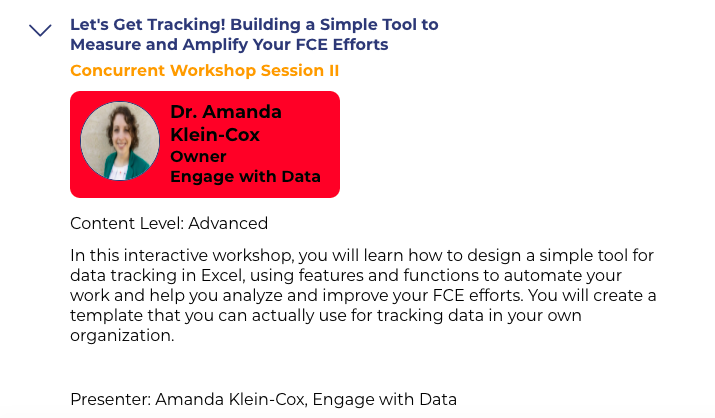
I’ve had some great opportunities lately to talk about tracking family engagement data and use logic models 


“Let’s Get Tracking” session information from IEL National Family and Community Engagement conference

Written by cplysy · Categorized: engagewithdata

  • « Go to Previous Page
  • Go to page 1
  • Interim pages omitted …
  • Go to page 179
  • Go to page 180
  • Go to page 181
  • Go to page 182
  • Go to page 183
  • Interim pages omitted …
  • Go to page 310
  • Go to Next Page »

Footer

Follow our Work

The easiest way to stay connected to our work is to join our newsletter. You’ll get updates on projects, learn about new events, and hear stories from those evaluators whom the field continues to actively exclude and erase.

Get Updates

Want to take further action or join a pod? Click here to learn more.

Copyright © 2026 · The May 13 Group · Log in

en English
af Afrikaanssq Shqipam አማርኛar العربيةhy Հայերենaz Azərbaycan dilieu Euskarabe Беларуская моваbn বাংলাbs Bosanskibg Българскиca Catalàceb Cebuanony Chichewazh-CN 简体中文zh-TW 繁體中文co Corsuhr Hrvatskics Čeština‎da Dansknl Nederlandsen Englisheo Esperantoet Eestitl Filipinofi Suomifr Françaisfy Fryskgl Galegoka ქართულიde Deutschel Ελληνικάgu ગુજરાતીht Kreyol ayisyenha Harshen Hausahaw Ōlelo Hawaiʻiiw עִבְרִיתhi हिन्दीhmn Hmonghu Magyaris Íslenskaig Igboid Bahasa Indonesiaga Gaeilgeit Italianoja 日本語jw Basa Jawakn ಕನ್ನಡkk Қазақ тіліkm ភាសាខ្មែរko 한국어ku كوردی‎ky Кыргызчаlo ພາສາລາວla Latinlv Latviešu valodalt Lietuvių kalbalb Lëtzebuergeschmk Македонски јазикmg Malagasyms Bahasa Melayuml മലയാളംmt Maltesemi Te Reo Māorimr मराठीmn Монголmy ဗမာစာne नेपालीno Norsk bokmålps پښتوfa فارسیpl Polskipt Portuguêspa ਪੰਜਾਬੀro Românăru Русскийsm Samoangd Gàidhligsr Српски језикst Sesothosn Shonasd سنڌيsi සිංහලsk Slovenčinasl Slovenščinaso Afsoomaalies Españolsu Basa Sundasw Kiswahilisv Svenskatg Тоҷикӣta தமிழ்te తెలుగుth ไทยtr Türkçeuk Українськаur اردوuz O‘zbekchavi Tiếng Việtcy Cymraegxh isiXhosayi יידישyo Yorùbázu Zulu