• Skip to main content
  • Skip to footer
  • Home

The May 13 Group

the next day for evaluation

  • Get Involved
  • Our Work
  • About Us
You are here: Home / Archives for allblogs

allblogs

Jun 02 2020

Teaching + Knowledge = Passion for Data Viz

One of the primary reasons for taking Ann’s data visualization course, Great Graphs, was to learn better ways to use Microsoft Excel as a visualization tool.

I am so excited to share how grateful I am to Ann and her colleagues for putting together an online training to share their talents with me. 

In return, I am paying it forward by teaching my Advanced Excel students at Central Washington University a tiny portion of how they can use Excel as a data viz tool and application. 

Here’s how my own work and my students’ work evolved after taking the data visualization course.

My Own Challenges to Communicating Results

One of the biggest challenges I faced as an evaluator was to show “differences” between “pre & post” or “before & after” an intervention other than a typical table of numbers.

Most evaluation reports were made up of narrative and making references to tables of results. When I heard about Ann K. Emery and how she used Excel to produce dynamic and creative stories about programs, I was all about learning more and so I enrolled in Simple Spreadsheets and Great Graphs last year.

Before: Tables to Show Pre-Post Differences

Here’s what my own work looked like before taking two of Ann’s courses—a table with key statistics.
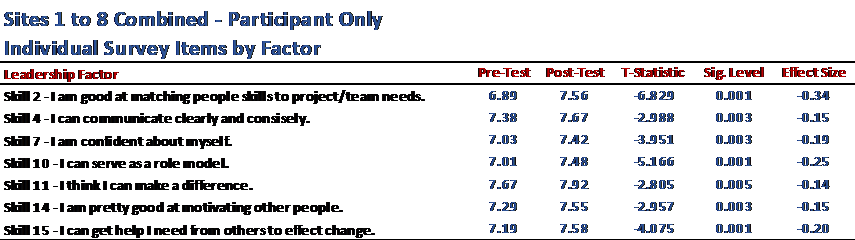
Here’s what my own work looked like before taking two of Ann’s courses—a table with key statistics.

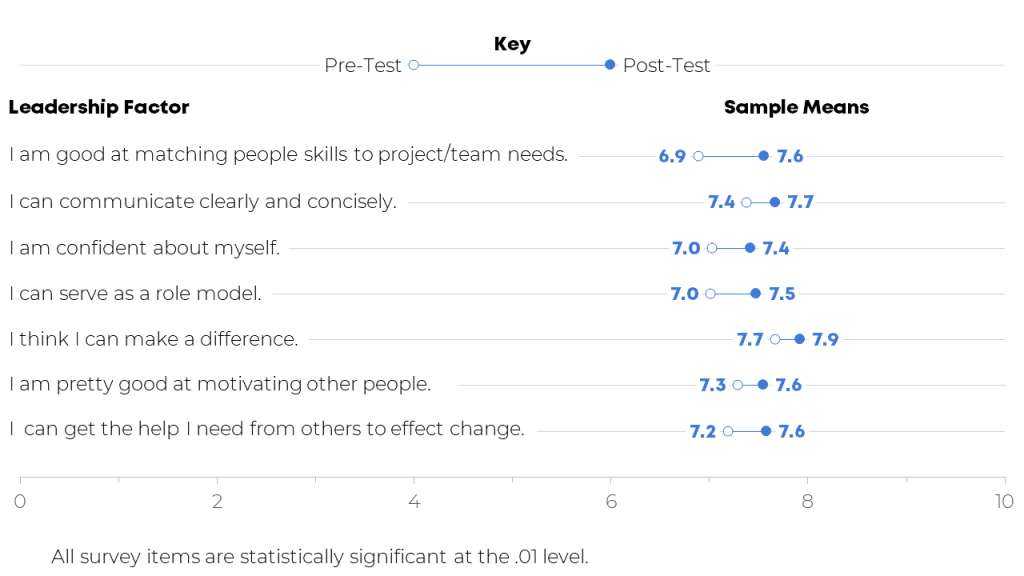
After: Dot Plots to Show Pre-Post Differences

I used several of Ann’s lessons in Great Graphs to create more visually appealing and easier to read charts to show differences in the intervention of leadership education for teens.

For example, I used Ann’s step-by-step process to create a dot plot chart to show the pre- to post-test difference.

She provided a template that walked me through each step of creating the dot plot and now I have the template to keep creating dot plots:
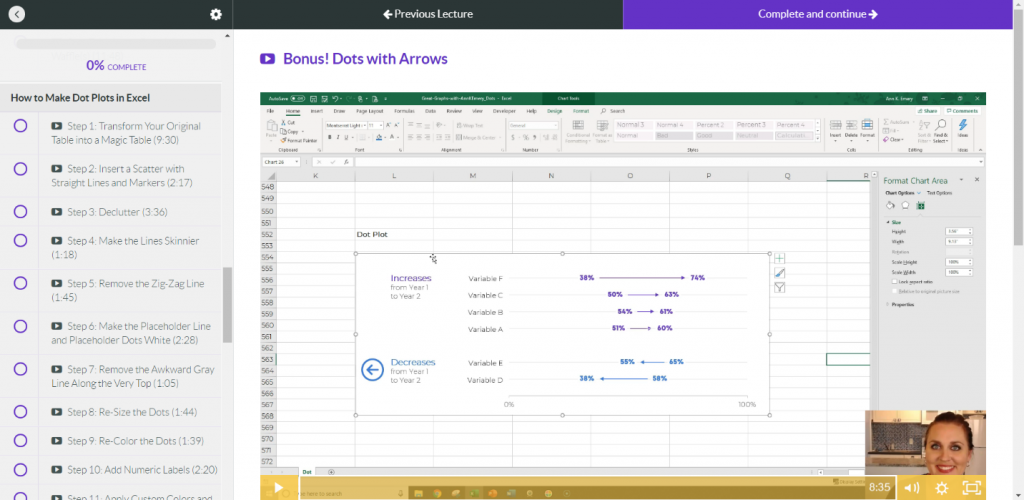
For example, I used Ann’s step-by-step process to create a dot plot chart to show the pre- to post-test difference.

Here’s what my work looks like now:

Here’s what my work looks like now after using Ann's methods.

Editing My Own Visuals

In addition to the dot plots, Ann provided clear instructions for how to work create, edit, declutter, and place charts in a variety of reporting formats.

Before: A Black and White Table with Little Font Size Variation

The next example is related to an individual survey item which was statistically significant between the participant and comparison group.
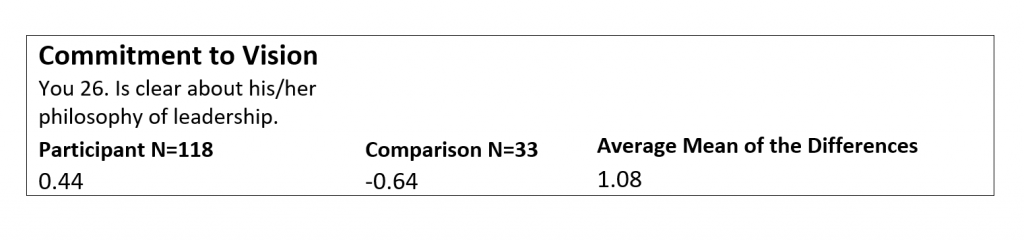
Before: A Black and White Table with Little Font Size Variation

After: Using Dark Colors and Larger Font Sizes to Highlight Key Details

The same information is included in each chart, but hopefully the “After” is easier on the eyes!
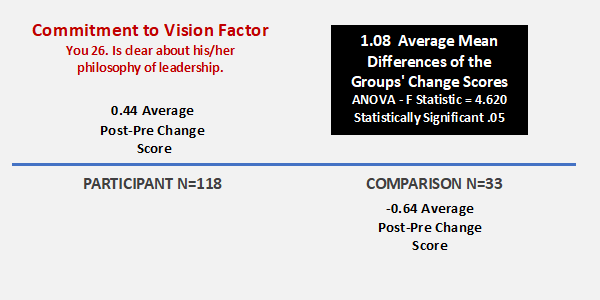
The same information is included in each chart, but hopefully the “After” is easier on the eyes!

Training University Students on Data Visualization

I also wanted to expose these tools and applications to students that are enrolled in the Advanced Excel Spreadsheets course at Central Washington University.

First, I require students to sign up for Ann’s Soar Beyond the Dusty Shelf Report mini course so they can get acquainted with what data visualization is and how they can use Excel beyond just pivot tables, what if statements, and business intelligence applications.

Next, there is one assignment for the students to use an existing set of data (i.e. work-related, volunteer project for non-profit, or choose a data set I provided for them) and create a “before” and “after” data viz using the tools and techniques from the mini course and an extensive review of Ann’s blog.   

A University Student’s Before-After Transformation

One of my students, Kelly, volunteers for a small newly organized non-profit organization. They needed help developing an overview of their organization and information showing how they are good stewards of financial donations.

Before: A Table

Here’s what the information used to look like: a table.

Here’s what the information used to look like: a table.

After: A One-Pager with Graphs and Narrative

Kelly provided a one-page document that briefly explained the organization’s mission and program, along with their non-profit status. 

She included two column charts as the data visualization portion of the document representing dashboard of finances (income) and stewardship of funds (expense/costs) to clearly define the majority of the contributions are in direct support of immigrant families. 

She also included small narrative blocks to briefly highlight grant and corporate donors, in the first block, and that the majority of funds raised go to directly support immigrant families.  Both corporate contributions and direct support of immigrant families were the two items that this organization wanted clearly stated.
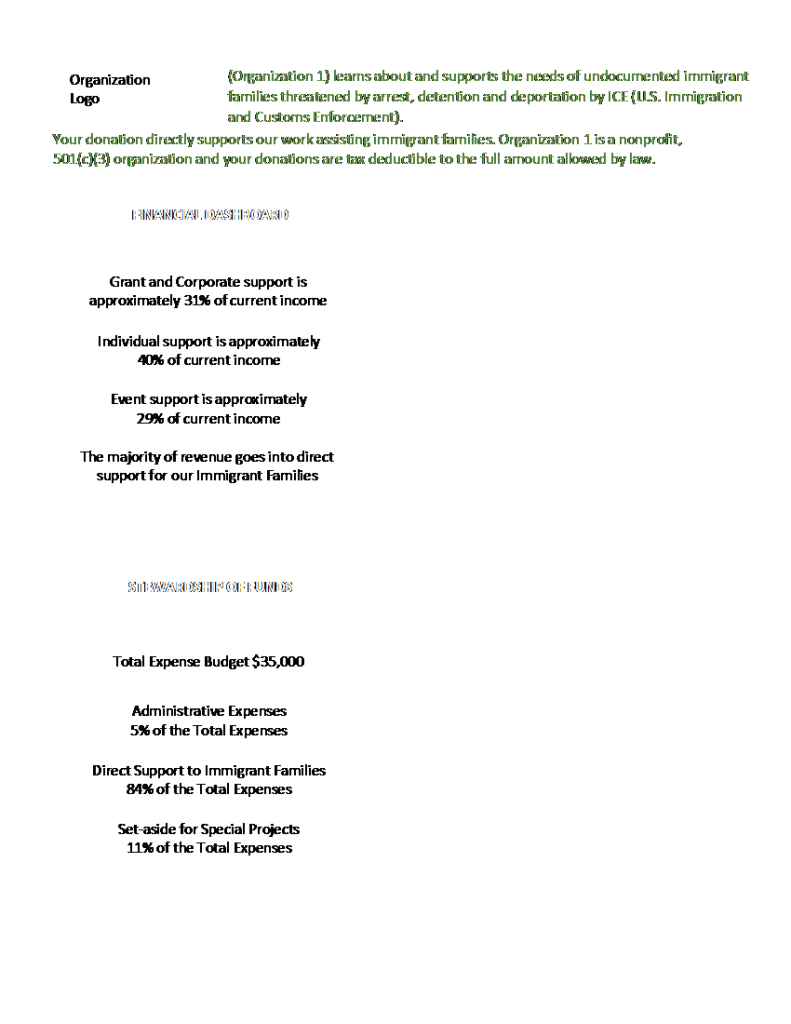
After: A One-Pager with Graphs and Narrative

I love to learn and one of my professional goals continues becoming a better communicator of information using data visualization tools and techniques.  I am going to continue seeking out opportunities with Ann and her team and learn more about data viz every day! 

Connect with Lori

Connect with Lori Thompson on LinkedIn: https://www.linkedin.com/in/lori-a-thompson-ph-d-8023b85a/.

Written by cplysy · Categorized: depictdatastudio

Jun 02 2020

La escucha activa en tiempos de crispación

En estos momentos con el contexto del Covid 19, vivimos en un entorno de crispación social (y algo más que crispación, por desgracia, en Estados Unidos). La escucha activa se hace más necesaria que nunca.

Escuchar, argumenta Erich Fromm, es “es un arte como la comprensión de la poesía” y, como cualquier arte, tiene sus propias reglas y normas. A partir de su práctica de medio siglo como terapeuta, Fromm ofrece seis pautas para dominar el arte de la comprensión desinteresada:

  1. La regla básica para practicar este arte es la concentración completa del oyente.
  2. No debe tener en mente nada importante, debe estar óptimamente libre de ansiedad y de avaricia.
  3. Debe poseer una imaginación que funcione libremente y que sea lo suficientemente concreta como para expresarse en palabras.
  4. Debe estar dotado de una capacidad de empatía con otra persona y lo suficientemente fuerte como para sentir la experiencia del otro como si fuera la suya.
  5. La condición para tal empatía es una faceta crucial de la capacidad de amar. Comprender a otro significa amarlo, no en el sentido erótico, sino en el sentido de llegar a él y superar el miedo a perderse.
  6. Comprender y amar son inseparables. Si están separados, es un proceso cerebral y la puerta a la comprensión esencial permanece cerrada.

La escucha activa es un “arte” que (a) requiere “disponibilidad, interés por la persona, comprensión del mensaje, espíritu crítico y prudencia en los consejos”, (b) consiste en una forma de comunicación que demuestra al hablante que el oyente le ha entendido. Escuchar activamente no se limita a dejar hablar al interlocutor sin interrumpir su discurso, sino que necesita de una atención física, psicológica y verbal que, por suerte, todos podemos mejorar. La escucha activa se refiere, como su nombre indica, a (1) escuchar activamente y con conciencia plena. No es oír a la otra persona, sino a (2) estar totalmente concentrados en el mensaje que el otro individuo intenta comunicar. (3) Es una técnica y estrategia específica de la comunicación humana, es utilizada en campos como la enfermería, la psicoterapia y la resolución de conflictos. (4) Implica asimismo,  ofrecer disponibilidad y mostrar interés por la persona que habla. Se refiere a (5) la habilidad de escuchar no sólo (a) lo que la persona está expresando directamente, sino también los (b) sentimientos, ideas o pensamientos que subyacen a lo que se está diciendo. (6) Consiste en una forma de comunicación que demuestra al hablante que el oyente le ha entendido.

Las barreras para la escucha activa tienen un gran impacto negativo en la moral y la productividad de la colaboración y del trabajo en equipo. Esta situación generalmente resulta en conflictos y malentendidos entre los miembros del equipo, y crea un ambiente negativo. Afortunadamente, las habilidades de escucha se pueden aprender. 1.Hablar excesivamente, 2.Prejuzgar, 3.Distracciones, 4.Esperar o dar por supuesto que otros comparten nuestras creencias y valores personales, 5.Malentendido, 6.Interrumpir o interrupciones, 7.Hacer que escuchamos: Falsificando la atencion, 8.Dejarse llevar por las emociones, 9.El Ruido, 10.El miedo o el temor

La comunicación es un proceso de interacción en el que se produce un intercambio de sentimientos, información, ideas, emociones, conocimiento y todo lo que conlleva la trasmisión de un mensaje que necesita ser retroalimentado. La mayor dificultad de la comunicación es pensar que es fácil. Comprender los procesos de comunicación implica ser mucho más minucioso y elaborado que solo articular los mensajes. La comunicación eficaz es aquella que establece una conexión de doble vía, la cual siempre tendrá una conducta de reciprocidad y respeto para con los demás.

La asertividad y la escucha activa no son conceptos contrapuestos. Debemos ser asertivos mientras practicamos la escucha activa y, por otra parte, una asertividad basada en la escucha activa suele ser más eficaz. Cuando nos encontremos ante afirmaciones, ataques o peticiones que no podamos hacer frente, debemos comunicárlo claramente, honestamente y con el máximo respeto.

Written by cplysy · Categorized: TripleAD

Jun 01 2020

Evaluation Roundup – May 2020


Welcome to our monthly roundup of new and noteworthy evaluation news and resources – here is the latest.

Have something you’d like to see here? Tweet us @EvalAcademy or connect on LinkedIn!


New and Noteworthy — Reads


One-Way Street of Knowledge Production and Sharing in The Evaluation Field

With the protests that are unfolding in Minneapolis, and now the rest of the world, it is worth reading (or re-reading) Khalil Bitar’s blog post from May 11. In the post he talks about how the evaluation community is not immune to prejudice, discrimination and racism, and is in fact practicing it by primarily producing and sharing evaluation knowledge by white men from the Global North. As he says, the evaluation community is not immune to racism and has an ethical responsibility to be more mindful, inclusive and open:

“The evaluation field should be among the leading fields in combating these convictions and practices. It is time for the field to systematically embrace and nourish views, thoughts, and experiences that have long been neglected.”

— Khalil Bitar

Good Practices for Evaluation During COVID-19

Recently OECD/DAC Network on Development Evaluation (EvalNet) and the Independent Evaluation Office of UNDP jointly prepared a guidance document that captures good practices for evaluations during COVID-19. In the document they provide insights, suggestions and practical examples for how to adapt evaluation work. These include:

  1. Do no harm,

  2. Take care of staff,

  3. Re-think evaluation plans,

  4. Adapt evaluation methods and approaches,

  5. Use information technologies and remote data solutions,

  6. Build on and support local capacities and

  7. Prepare for future evaluations.


Zenda Ofir – Transforming Evaluations Part 5. COVID-Safe, COVID-Ready and COVID-Informed Evaluation

The guidance document produced by the OECD/DAC and UNDP-IEO (referenced above) is a good illustration of a COVID-Safe evaluation – it focuses on details of what to do and how to  adjust our evaluations in a crisis situation. In this blog post, @ZendaOfir also explores COVID-Ready and COVID-Informed evaluation. She goes on to explain that many believe that we might have to live with COVID if a vaccine or cure is not found. Therefore, COVID-Ready evaluation focuses on what should be evaluated in the event of an ongoing crisis that will help people and societies cope. Yet, Ofir goes on to say that COVID-Ready evaluation is not enough since it focuses on recovery and preparedness “more or less within the status quo and in the short to medium term.” COVID-Informed evaluation, she says, has a long-term perspective that focuses on preparing humanity for sustainable development and resilient societies.  


Zenda Ofir – A Beautiful Practice for our time

Looking for some more insights by @ZendaOfir? She wrote a blog post that seemed to create a bit of chatter on Twitter. Some agreed with @ZendaOfir and her thoughts on if/how evaluation contributes to beauty in this world, while others did not. In this post, Zenda Ofir offers that “evaluation as practice is intrinsically beautiful – but how it is practiced, frequently not.” She goes on to outline seven reasons for why she considers evaluation as something “beautiful”. What do you think? Do you agree?


New and Noteworthy — Tools


Quick reference guides evaluators can’t live without

Kudos to Kelly Robertson from EvaluATE for pulling together so many checklists, guides and other resources. These are organized according to evaluation activity and can be found here on EvaluATE’s website. I have to say, the Likert-Type Scale Response Anchors developed by Vagias and Wade is one I reference frequently!


New and Noteworthy — Courses, Events and Webinars


June 2020

  1. gLOCAL Evaluation Week (June 1- 5, 2020) – Online, free events

    • Host: Centers for Learning on Evaluation and Results

  2. Rewiring Evaluation Approaches at the Intersection of Data Science and Evaluation – Webinar

    • Host: World Bank – Independent Evaluation Group

  3. Feminist Evaluation: Not your standard gender-responsive approach! – Online Course

    • Instructor: Donna Podems (@DonnaPodems)

  4. Transformative Mixed-Methods Evaluation – Online Course


July 2020

  1. Results-based Management & Theory of Change Workshop during and after COVID-19

    • Instructor: Mosaic.net International Inc.


We have a free guide:

Applying the JCSEE Evaluation Standards in Practice

Whether you’ve read The Program Evaluation Standards cover to cover or not, you may be wondering how to ensure you’re applying them to your evaluation practice. This free digital download will give you the reflective prompts you need to ensure your next evaluation project incorporates all 30 Standards.


Subscribe to Our Newsletter

Sign up with your email address to receive news and updates from Eval Academy every month.


We respect your privacy.

Thank you!


Written by cplysy · Categorized: evalacademy

Jun 01 2020

Black Lives Matter

We have been working to actively post on our blog over the past few months in response to how COVID-19 is affecting the museum field.  However, considering the unjust deaths of George Floyd, Breonna Taylor, and others, and in solidarity with the protests unfolding daily against systemic racism in our country, we will be pausing our normal content.  Please listen to the voices of people of color and those advocating for black lives—for example, the National Museum of African American History and Culture’s web portal to support conversations about race.  Black Lives Matter.

The post Black Lives Matter appeared first on RK&A.

Written by cplysy · Categorized: rka

May 31 2020

We have to do better.

I still remember how scared I was during the 2015 riots/uprising in Baltimore after the death of Freddie Gray. 

I understood the pain and outrage in the black community over the death of a young, black man in police custody, but looking back, I didn’t really get the depth of the collective trauma that was at the heart of it. 

At the time, I was a Community School Coordinator at a predominately black elementary school about two miles down the road from Mondawmin Mall, the epicenter of the protests. As word spread of a student-led protest at Mondawmin that afternoon, staff and families began to fear for the safety of our students as they left school for the day. I had to take a different route on my way home, since I always passed the mall on my drive. On my detour, I passed armored National Guard tanks and heavily armed soldiers. It was clear that this was much more than a student-led protest. I was rattled.

That night, I holed up in my apartment and spent the entire evening glued to the news, unable to do anything but watch my city burn. Living close to downtown, I heard a lot of noise outside that night, but I was shocked to wake up and find buildings across the street boarded up, having been broken into the night before. 

I felt that same initial shock this weekend when I saw images of my new city – Columbus, OH – on fire. While still frightening, I had a different understanding of the situation than I did five years ago. 

In the five years since that night, I have continued to study, listen, and learn about the deeply institutionalized racism in this country and the violence that still accompanies it in modern-day America. I now have a better understanding of how intensely traumatized our black communities are from centuries of oppression, discrimination, and brutality, and I also know that I can never truly know that pain for myself.

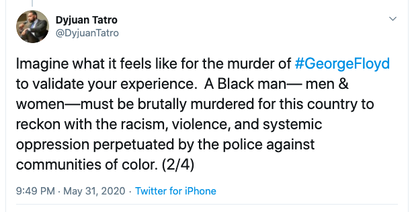
So the recent surge in senseless and hate-fueled killings of black men and women in this country has rested heavy on my heart. I’ve felt sick over the horrific and unnecessary deaths of Ahmaud Arbery, Breonna Taylor, and George Floyd in recent weeks … and so many others before them. I’ve heard the friends and colleagues I love question their own self-worth and the safety of their children just because of the color of their skin. Dyjuan Tatro, featured in the moving series College Behind Bars, about the Bard Prison Initiative, summed this up so eloquently: 

Picture

And yet, police brutality has only proliferated this week. I’ve watched videos of officers driving their cars into crowds of protesters, pulling down a young man’s mask and pepper spraying him, and shooting protesters and journalists in the face with “non-lethal” bullets. 

There is no reason for it, and there is no excuse. The blatant racism and hate crimes in our country must be prosecuted and condemned. 

But let’s think for a moment about our country’s black youth. On top of this historical and racial trauma that so many of them carry before they are old enough to understand it, they also attend under-resourced, hyper-segregated schools … and yet, we expect them to learn and function like those who are lucky enough to live without these burdens. 

It doesn’t make sense. We have to do better.

​I’m still grappling with my role in all of this and how I can try to make the world a bit better. I will continue to serve and support communities and school districts serving black and brown youth, but somehow that doesn’t feel like enough. I hope that as a nation, we can collectively remember that there is a common good, and that it is far easier to stand for that than to stand for hate. ​

Written by cplysy · Categorized: engagewithdata

  • « Go to Previous Page
  • Go to page 1
  • Interim pages omitted …
  • Go to page 260
  • Go to page 261
  • Go to page 262
  • Go to page 263
  • Go to page 264
  • Interim pages omitted …
  • Go to page 310
  • Go to Next Page »

Footer

Follow our Work

The easiest way to stay connected to our work is to join our newsletter. You’ll get updates on projects, learn about new events, and hear stories from those evaluators whom the field continues to actively exclude and erase.

Get Updates

Want to take further action or join a pod? Click here to learn more.

Copyright © 2026 · The May 13 Group · Log in

en English
af Afrikaanssq Shqipam አማርኛar العربيةhy Հայերենaz Azərbaycan dilieu Euskarabe Беларуская моваbn বাংলাbs Bosanskibg Българскиca Catalàceb Cebuanony Chichewazh-CN 简体中文zh-TW 繁體中文co Corsuhr Hrvatskics Čeština‎da Dansknl Nederlandsen Englisheo Esperantoet Eestitl Filipinofi Suomifr Françaisfy Fryskgl Galegoka ქართულიde Deutschel Ελληνικάgu ગુજરાતીht Kreyol ayisyenha Harshen Hausahaw Ōlelo Hawaiʻiiw עִבְרִיתhi हिन्दीhmn Hmonghu Magyaris Íslenskaig Igboid Bahasa Indonesiaga Gaeilgeit Italianoja 日本語jw Basa Jawakn ಕನ್ನಡkk Қазақ тіліkm ភាសាខ្មែរko 한국어ku كوردی‎ky Кыргызчаlo ພາສາລາວla Latinlv Latviešu valodalt Lietuvių kalbalb Lëtzebuergeschmk Македонски јазикmg Malagasyms Bahasa Melayuml മലയാളംmt Maltesemi Te Reo Māorimr मराठीmn Монголmy ဗမာစာne नेपालीno Norsk bokmålps پښتوfa فارسیpl Polskipt Portuguêspa ਪੰਜਾਬੀro Românăru Русскийsm Samoangd Gàidhligsr Српски језикst Sesothosn Shonasd سنڌيsi සිංහලsk Slovenčinasl Slovenščinaso Afsoomaalies Españolsu Basa Sundasw Kiswahilisv Svenskatg Тоҷикӣta தமிழ்te తెలుగుth ไทยtr Türkçeuk Українськаur اردوuz O‘zbekchavi Tiếng Việtcy Cymraegxh isiXhosayi יידישyo Yorùbázu Zulu