• Skip to main content
  • Skip to footer
  • Home

The May 13 Group

the next day for evaluation

  • Get Involved
  • Our Work
  • About Us
You are here: Home / Archives for allblogs

allblogs

Sep 24 2022

Collective Impact Model (The Basics)

Written by cplysy · Categorized: connectingevidence

Sep 23 2022

Are you reporting or documenting?

Do you know why so many research and evaluation reports are super long and boring? I have a theory.

Freshspectrum Cartoon.
"Wow, that's a lot of words."
"Can you believe I was able to fit my entire masters' thesis on a single research poster?"

One nice thing about putting all of your ideas into a book is that it makes it easier to chat about those ideas with others. And I’ve had the opportunity to participate in a bunch of chats about The Reporting Revolution.

A point that I make in the book is that it’s probably better to have 10 pretty good reports that reach 10 unique audience needs than to have 1 amazing report. I also talk a lot about different types of micro-reports (i.e. social media featured images, infographics, slidedocs, etc.).

This gets a little pushback, but not because I’m suggesting creating lots of little reports. Instead, it’s the idea that we shouldn’t create one big report. Because we need that report to do other things.

For example, we need the report as a historical record of the work that we’ve completed. Something that walks systematically through the methods we’ve used, talks about how we approached our analysis, and goes over any complications or considerations. Not because there is someone who specifically needs that information right now, but because somebody might need that information at some point in the future.
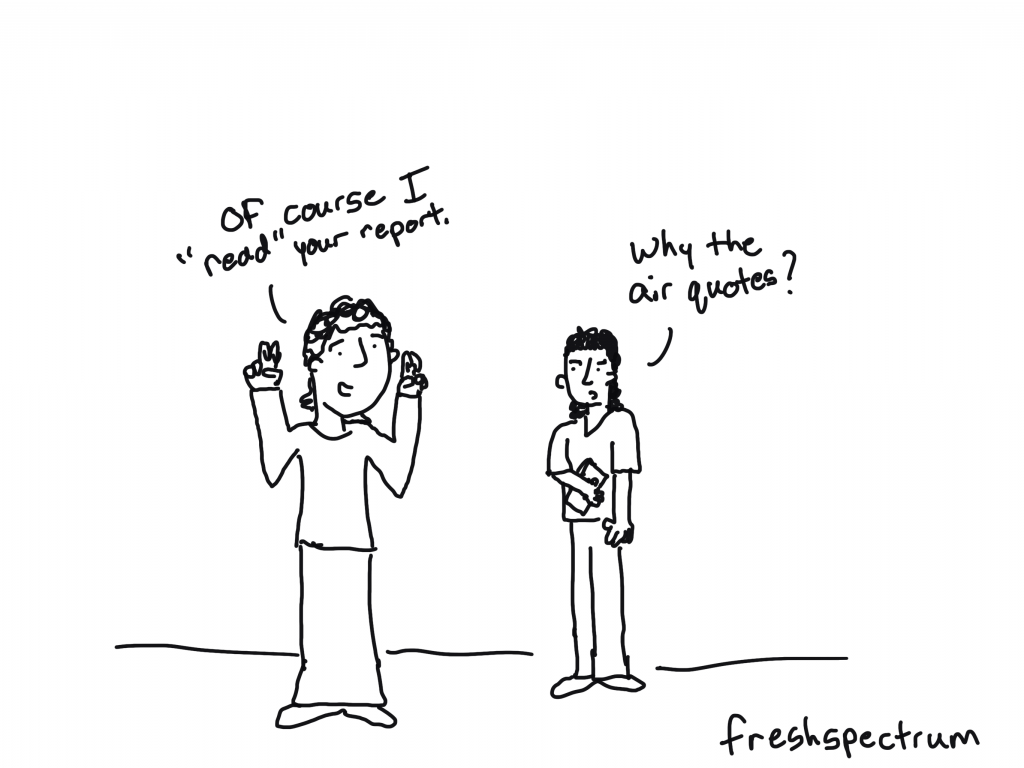
Freshspectrum cartoon - 
"Of course I "read" your report."
"Why the air quotes?"

Reporting versus Documentation

My love of little reports does not mean that I am against long reports. I have even written in defense of long 200 page reports.

Not only do long reports provide a historical record of our work, but they also help us to think through our work and let us write non-comprehensive short reports without the fear of missing something.

But merited or not, are these long brain dumps really reports?

Yes, we call them reports. But we don’t really create these things for people. We create these things to document our work.

We report for audiences.
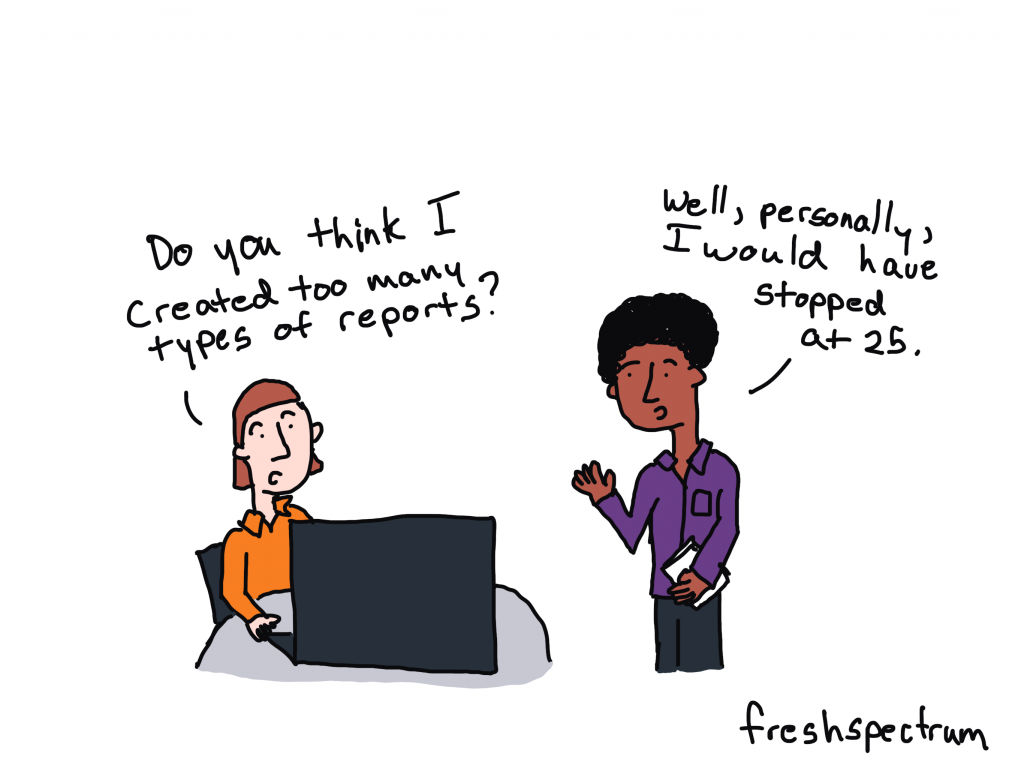
Freshspectrum cartoon -
"Do you think I created too many types of reports?"
"Well, personally, I would have stopped at 25"

What would happen if you started calling your longer reports documentation?

If you give up the idea that you’re actually writing for an audience, the whole “formerly known as long report” thing gets easier to write. Because you’re just capturing your work.

And if you stop treating that documentation as the only way you report your work, you can start creating real reports. The ones designed to serve your audiences.
Written by cplysy · Categorized: freshspectrum

Sep 20 2022

Mapping community organizing models: An adapted journey mapping approach

Before the pandemic, Innovation Network partnered with Community Change to document the community organizing models of the nine local grassroots organizations in their Power in Places initiative. One common feature of the organizations (nine grassroots groups across eight states) we worked with is that they were always adapting their community organizing model. Whether they came from an Alinsky tradition or designed their own approach, they were modifying and adapting to fit the needs of the current day and unique makeup of the people in their communities.

When we were asked by Community Change, a national intermediary organization for these organizations, to write down these unique approaches and adaptations, we did not anticipate how useful it would become for the organizations themselves.

Organizers appreciated time to reflect on their model. Organizers are busy strategizing, researching, knocking on doors, and building relationships. They often don’t have time to stop and reflect on why and how what they are doing is working. We heard from organizers that just the act of reflecting and articulating their organizing model was helpful.

Organizing models support peer learning. Although the groups we worked with organized in different states and contexts, they often faced similar challenges, such as organizing across difference and finding a balance between building their membership and growing leaders. When organizations read each other’s models, they were able to identify and connect with other groups addressing similar challenges and come up with fresh ideas.

Documentation helps validate community organizing approaches. Community organizing is undervalued and poorly understood. Formal documentation of the strategies and complexities embedded in community organizing can help funders and partners understand and appreciate the role of organizing in social change. Organizers can share their organizing models with staff during orientation, in proposals for grant writing, and with partners to describe their role in coalitions.

Our site visit with organizers was the one time we would be together in person to deeply understand their unique models of collective action. We wanted to find out and document exactly what their models for building the power of everyday people looked like. We have outlined our process for documenting organizing models, along with some insights, below.

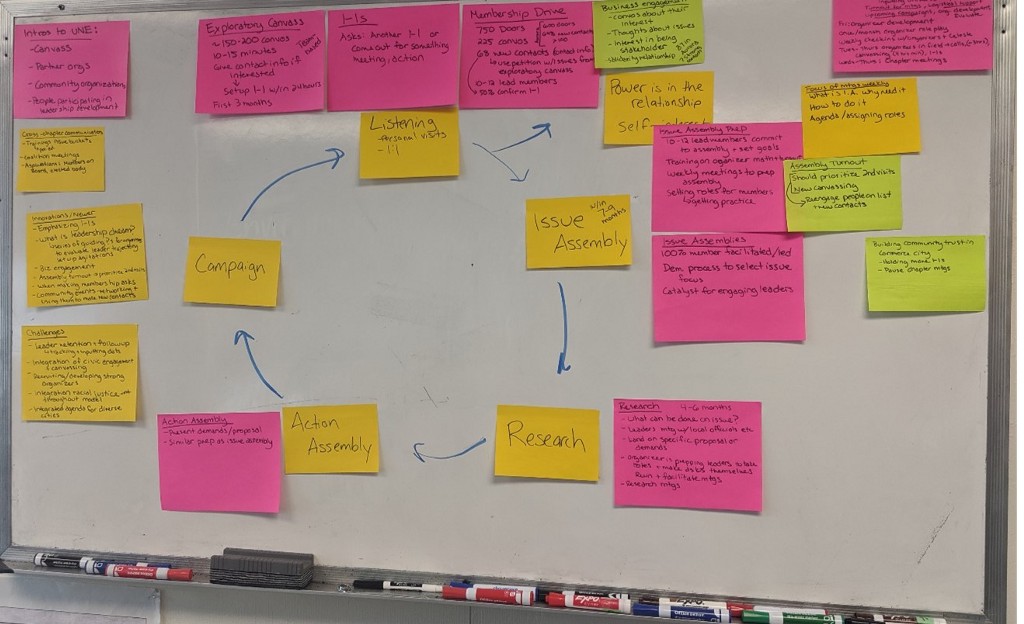
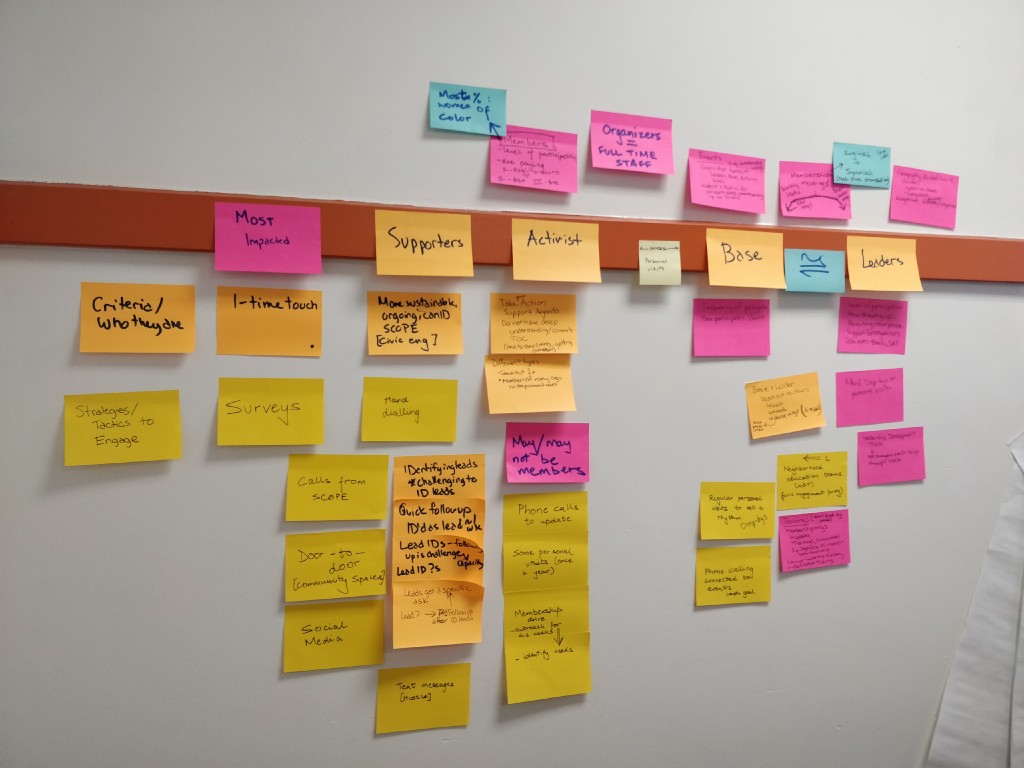
Post-its describing one organization’s model cover the wall during a site visit

Our goal was to get descriptive detailed information, to understand what a person would experience from the time an organizer knocked on their door (in one possible scenario of outreach) to the time that person becomes a member and leader of the community organization. Ultimately, we decided to use an adapted Journey Mapping approach. Journey Mapping is a process adapted from Silicon Valley for designing the user experience of people who engage with apps and websites. We used a similar process to map the experience of a person who connects with and builds their leadership through community organizing.

We found that this style of approach — using post-its and plotting them on the wall — helped us gain more clarity than a traditional interview. Organizers were able to clarify and add more detail when they saw what was written on the wall. And it helped move us along when we placed an empty post-it and asked organizers to fill it in.

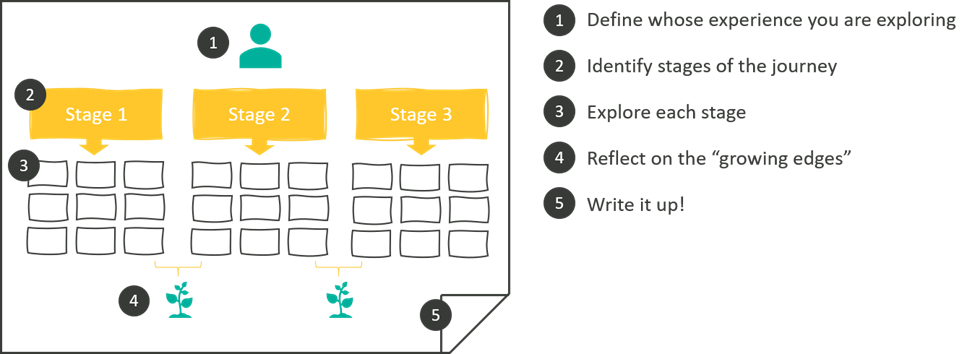
Our process included five steps:

  1. Define whose experience you are exploring
  2. Identify stages of the journey
  3. Explore each stage
  4. Reflect on the “growing edges”
  5. Write it up!

While we used this process to find a common model of community organizing, this approach could easily be used for any evaluation that seeks to capture a progressive model, e.g., increasing person or organizational capacity, member engagement, etc.

1. Define whose experience you are exploring

It’s hard to understand someone’s journey before you have a better understanding of who they are, what influences them, and the context in which they live. In our case, we were curious about the members of grassroots organizations whose journeys we mapped. Before we mapped the organizing models, we spent time learning about members and the communities they come from.

Although organizing looked different in each of the nine organizations we worked with, their members experienced similar challenges of being disproportionately impacted by racial, social, and economic inequities and injustice. Their strengths were unique: members in some states were connected to strong churches or local groups, while others have a history of civic involvement. One community organized in California had a strong grounding in the civil rights movement and has long fought against oppression. Understanding the world in which members lived helped us see how the model to organize them was constructed to respond to the needs and strengths of its members.

Questions for exploring the “who”:

Tell us about the community you organize. Who lives in the community? Who are the types of people you organize? Where do they live?

What is the demographic makeup of the community?

What challenges are they experiencing right now?

What are the strengths of this community?

Post-its describing one organization’s model cover the wall during a site visit

2. Identify stages of the journey

By identifying stages of a person’s journey you are creating a framework for the model that you will fill in later. You can start mapping stages at any point of a person’s journey. It doesn’t have to be the beginning, just a common experience of members. Start where there is energy. In our case, organizers we spoke with mentioned outreach activities to engage new members so we started there.

Write the stage on a post-it and place it on the wall or somewhere visible. You could do this virtually using tools such as Mural or Jamboard. Continue to add stages by asking what members experienced after, or leading up to, the plotted stage.

As we plotted stages, grassroots organizations described their work as linear, cyclical… even as a “tornado.” We did our best to place post-its in a way that represented the structure they described. If you’re limited by the wall space you have — don’t worry. Just get the stages down and take note of the structure discussed so you can capture it later.

For example, one organization outlined five stages of their organizing model: Listening, issue assembly, research, action assembly, and campaign.

NOTE: In a few cases, we had two parallel stages for different arms of the work. For example, one organization organized individuals as well as congregations, and had different approaches initially for getting members involved and building leadership. It was key to listen to organizers and map the process as they described it, in this case showing two parallel sequence of stages rather than one.

Questions for identifying stages:

What is a key stage or benchmark in people’s development and engagement, e.g., “first contact” with community members?

How do members go from first contact to becoming a leader? What milestones do they accomplish in between?

(If it is difficult to identify specific stages) Can you tell me the story of a specific community member that illustrates your approach to organizing? Walk us through what your organizing looked like from that person’s experience.

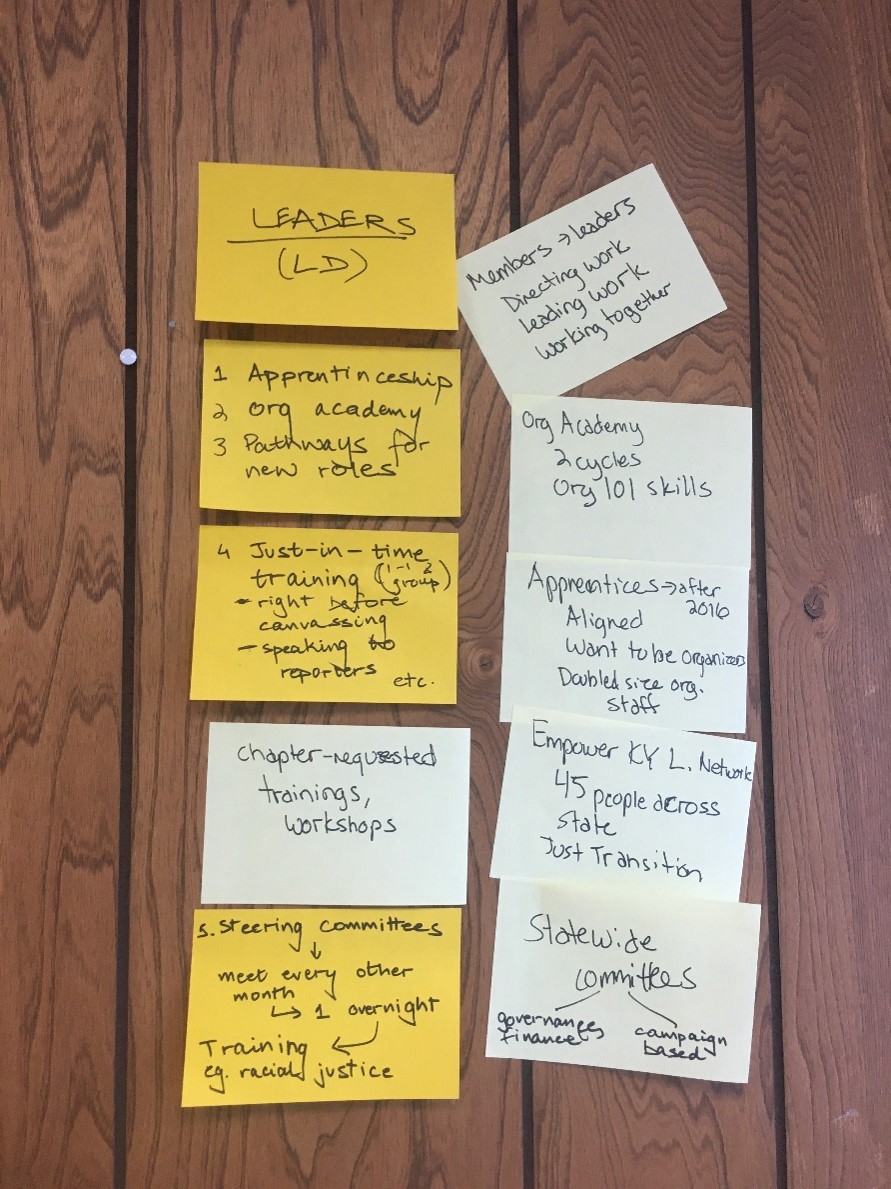
Post-its describing the detail of the leadership development aspect of one partner’s organizing model

3. Explore each stage

Take time to explore the specific strategies and tactics that organizers use to develop community members into leaders. Write these down on different color post-its and place them around the stage you are describing. This provides important details to understand what a person experiences that motivates them to continue to the next stage of the model.

Our goal was to get at a common model — not the small changes made day-to-day by unique organizers for unique members. This meant we had to stay within a specific timeframe, usually the most recent campaign conducted. We also framed the features of stages as what most members experienced. For example, if one member opted for conducting house parties as a part of their outreach but it was not a common practice, we did not include it in our model.

Questions for exploring stages:

What is the goal for this stage? What does successful engagement look like?

What does a community member’s engagement with the organization look like in this stage?

What qualities or requirements are expected of a person in this stage?

What strategies and tactics do you use for recruiting/developing members into leaders?

NOTE: Alternatively, you can dig into each stage as you identify it. We did a little of both and allowed the conversation to flow — capturing the stages, probing deeply as we went. Then we filled in the gaps once we had all the stages on post-its on the wall.

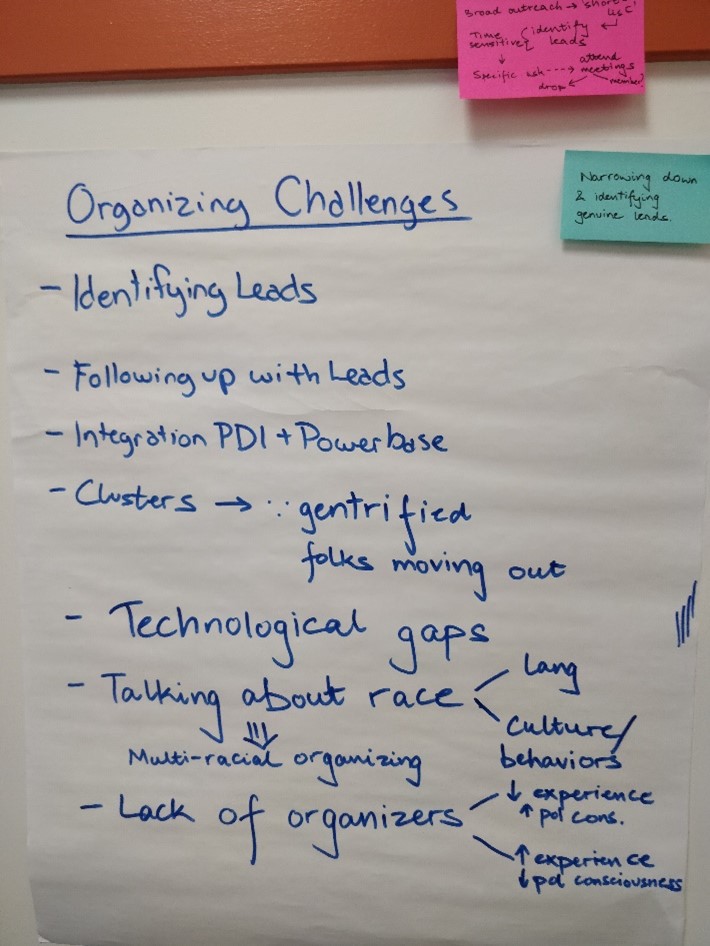
Some of the challenges, or “growing edges” identified by one partner in the process

4. Reflect on the “growing edges”

Once you have a good understanding of the major stages, strategies, and tactics, take a step back and reflect on the model overall. Often there are overarching elements that are helpful to explore, particularly what new strategies the organizations were experimenting with, and the challenges they were adapting around (the “growing edges”). These can be written on another color post-it on each side of the model.

Questions for reflecting on the model:

Which elements of your approach are newer or experimental?

What led to these adaptations (probing for challenges affecting the organizing model)?

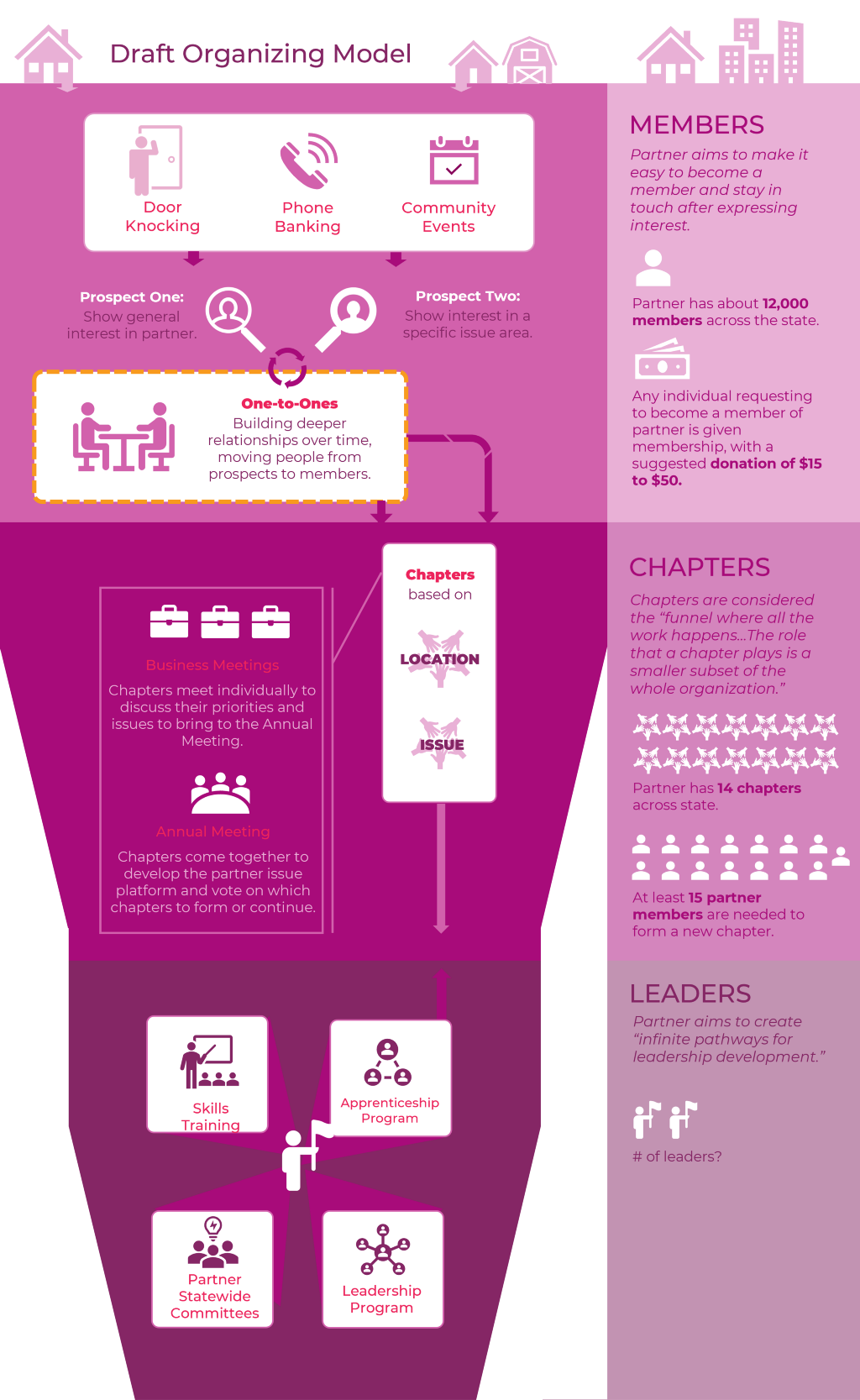
Draft organizing model, showing the trajectory from base-building, to developing chapters, to building leadership
Image of a draft organizing model for one organization built in PowerPoint. Visuals were accompanied by a more detailed narrative description.

5. Write it up!

When you have the full story, snap pictures of the post-its on the wall. Use these with notes from your conversation to create a product that describes the model you’ve captured. Models can be captured in any format! (Don’t be afraid to get creative — if a traditional report works for your audience that’s great, but consider alternative formats too, such as a cartoon strip, video, or SlideDoc.) Whatever you use, remember to describe the model using the same language (e.g., tornado!) that organizations use.

We created two products from this journey mapping exercise: a) a narrative detailing each stage and the “growing edges,” and b) a one-page visual depiction of the model to understand members’ experience at a glance. Organizers worked with us through a couple rough drafts before we came to agreement on a final version.

NOTE: We designed the narrative in Microsoft Word and the visual in PowerPoint. We knew that organizations’ models would continue to change and wanted to give them a tool that they had the power to update and use as they wished. Several organizers shared with us that they appreciated this foresight!

We shared the compilation with all nine organizations, hoping they would identify with others’ models and use them as an opportunity to connect. We created a set of guiding questions to think about as they read over each other’s models, and some questions to help them think about how they can use their own model as well, captured below.

Questions for learning from the model:

How has the model changed over time? What do these changes reflect about your approach or your community?

How can this model be used to educate new members, organizers, and funders?

What can you learn from others’ organizing models?

Have you tried participatory approaches to capture organizing or other community-based models? Please share your own ideas and experiences in the comments!

Mapping community organizing models was part of a larger evaluation that contributed to a framework for building people power. The framework and evaluation findings were published in the report, Power Building in the Community Change Power in Places Initiative: Framework & Strategies, and a New Directions Article written by my colleagues Katie Fox and Margaret Post, Evaluating Power Building.


Mapping community organizing models: An adapted journey mapping approach was originally published in InnovationNetwork on Medium, where people are continuing the conversation by highlighting and responding to this story.

Written by cplysy · Categorized: innovationnet

Sep 14 2022

Comment on Tools I use to Be Productive—And Maintain My Sanity by Managing my Research Pipeline using Todoist

[…] been writing for a long while about how Todoist is my brain. I’ve been using it since 2014 and every year it has gotten better and better at doing what I […]

Written by cplysy · Categorized: danawanzer

Sep 14 2022

Managing my Research Pipeline using Todoist

I’ve been writing for a long while about how Todoist is my brain. I’ve been using it since 2014 and every year it has gotten better and better at doing what I love: manage my tasks.

Want to learn how to use Todoist to help you have an efficient semester? Check out my mini course!

However, up until recently, I felt that was all it could do, and I kept looking for another system to better manage projects. I used Notion for a time, sharing four Notion templates for how I used it to track my research pipeline, student thesis projects, summer goals, and course prep notes. I used Notion for about six months before moving away from it. It was complicated, cumbersome, and just more hassle than benefit for me personally, although I still recommend it for folks interested in really powerful workspace platforms.

Next, I tried ClickUp. I was so excited to try it out and use it. I thought it would be the answer! And for many people it is, but it was similarly more than I needed and after 3 months of being all-in with trying it out, I went back to Todoist yet again.

These days, I am now using Todoist as my project management system. Does it have all the bells and whistles of other project management systems? Probably not. But does it do everything I need to do in an intuitive, easy to navigate fashion? Totally!

It’s particularly when they implemented the boards view that I fell in love with Todoist for the thousandth time. With Kanban style boards, which was really just another organizational scheme they implemented, I finally felt like I could do what a lot of other folks were using with other systems. And the first place I used it with was my research pipeline.

I’ve seen people use white boards, Excel spreadsheets, post-it notes, Trello boards, Notion, and so much more to track their research pipeline. And, in fact, I’ve tried them all too! But they would last only a few months before I forgot about them or just grew annoyed with them. That’s because they couldn’t integrate into my regular habits well. Sure, I could have done more to make them work, but I’d rather create systems that work for me than force myself into new systems that may not work.

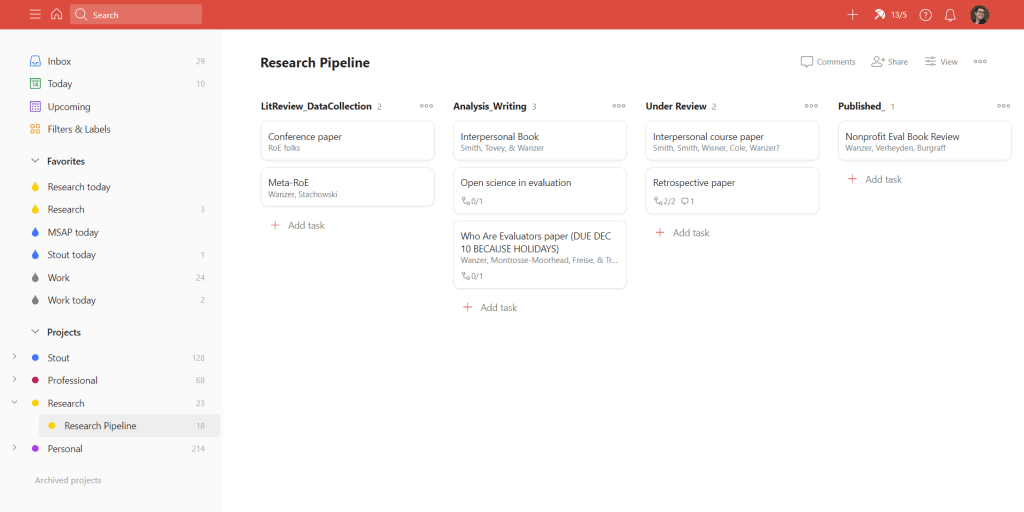
Here’s how I setup my research pipeline in Todoist. First, I created a unique project called “Research Pipeline” which I treat separately from my research project tasks (note the larger project called “Research”).

Second, within that project I have four sections which I have personally chosen to be LitReview/Data Collection, Analysis/Writing, Under Review, and Published. Not shown here is a fifth section called Ideas that I jot down notes for future potential projects. Note that Todoist doesn’t like characters in section names which is why there are underscores, but you can play around with the names that work best for you.

Third, under “View” I choose to View as Board and Group by Default (which is sections). Then you get the view I have above!

Lastly, each research project or paper is added as an uncompletable task. Note that there are no circles to “complete” tasks because those get put in the Published category to celebrate my accomplishments! Although don’t look too closely there because many of my published articles aren’t there right now because I implemented this system after publishing most of my current articles 🙂

I have been using the Description field to put the journal or author information. I have been using sub-tasks and comments to organize some broad thoughts about the papers or projects that aren’t really specific tasks.

I then use the Research project (see the left menu for my projects list) to organize my tasks themselves. I choose to have tasks in the project on Todoist called Research with Labels for which research project they are part of. I then view as a board but group by labels. I could also organize them by sections and it would do a similar thing.

Learn more about how to implement Todoist into your semester planning systems in my mini course!

Written by Dana Wanzer · Categorized: danawanzer

  • « Go to Previous Page
  • Go to page 1
  • Interim pages omitted …
  • Go to page 116
  • Go to page 117
  • Go to page 118
  • Go to page 119
  • Go to page 120
  • Interim pages omitted …
  • Go to page 310
  • Go to Next Page »

Footer

Follow our Work

The easiest way to stay connected to our work is to join our newsletter. You’ll get updates on projects, learn about new events, and hear stories from those evaluators whom the field continues to actively exclude and erase.

Get Updates

Want to take further action or join a pod? Click here to learn more.

Copyright © 2026 · The May 13 Group · Log in

en English
af Afrikaanssq Shqipam አማርኛar العربيةhy Հայերենaz Azərbaycan dilieu Euskarabe Беларуская моваbn বাংলাbs Bosanskibg Българскиca Catalàceb Cebuanony Chichewazh-CN 简体中文zh-TW 繁體中文co Corsuhr Hrvatskics Čeština‎da Dansknl Nederlandsen Englisheo Esperantoet Eestitl Filipinofi Suomifr Françaisfy Fryskgl Galegoka ქართულიde Deutschel Ελληνικάgu ગુજરાતીht Kreyol ayisyenha Harshen Hausahaw Ōlelo Hawaiʻiiw עִבְרִיתhi हिन्दीhmn Hmonghu Magyaris Íslenskaig Igboid Bahasa Indonesiaga Gaeilgeit Italianoja 日本語jw Basa Jawakn ಕನ್ನಡkk Қазақ тіліkm ភាសាខ្មែរko 한국어ku كوردی‎ky Кыргызчаlo ພາສາລາວla Latinlv Latviešu valodalt Lietuvių kalbalb Lëtzebuergeschmk Македонски јазикmg Malagasyms Bahasa Melayuml മലയാളംmt Maltesemi Te Reo Māorimr मराठीmn Монголmy ဗမာစာne नेपालीno Norsk bokmålps پښتوfa فارسیpl Polskipt Portuguêspa ਪੰਜਾਬੀro Românăru Русскийsm Samoangd Gàidhligsr Српски језикst Sesothosn Shonasd سنڌيsi සිංහලsk Slovenčinasl Slovenščinaso Afsoomaalies Españolsu Basa Sundasw Kiswahilisv Svenskatg Тоҷикӣta தமிழ்te తెలుగుth ไทยtr Türkçeuk Українськаur اردوuz O‘zbekchavi Tiếng Việtcy Cymraegxh isiXhosayi יידישyo Yorùbázu Zulu